
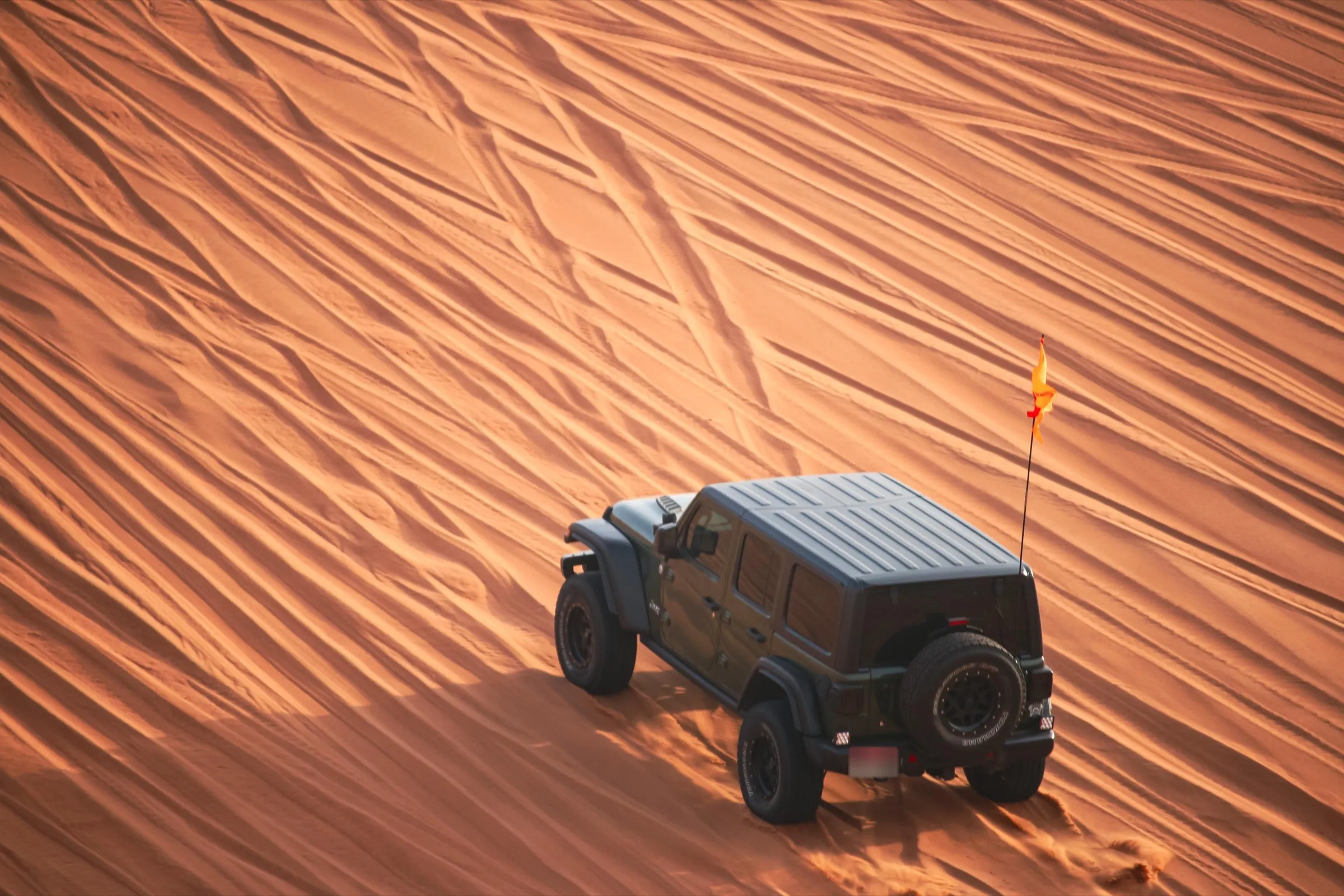
How dangerous is a dune side-slope?
Yes. Crossing a camber is normal dune technique, not a mistake. Newcomers are often told “never drive across a slope.” That advice is wrong, and following it in the UAE would make most dune driving impossible. Side-slopes are everywhere: the bowls at Big Red, the long faces out towards Liwa, the ridges around Fossil Rock.
What actually rolls people isn’t crossing the slope. It’s what happens when they slow down, brake or bog while tilted. Lose momentum on a camber and the low side digs in. The tilt grows past what the dune alone would give you. Your weight then moves out over the downhill wheel.
Why does a 4x4 roll sideways so easily?
Because it’s taller than it is wide. A vehicle tips when its centre of gravity moves outside the line of its wheels. It then pivots over the downhill pair. The track (the left-to-right spacing between the wheels) is narrower than the wheelbase. So the sideways lean you can survive is much smaller than the climbing angle you can survive.
A tall, loaded SUV makes it worse. High roof, roof rack, cabin full of gear: everything you add up high raises the centre of gravity and shrinks the angle the car will hold. That’s a hard limit set by your vehicle and your load. No amount of driving skill gets around it.
On real dunes you rarely roll because the camber alone crossed that limit. You roll because something added tilt at the wrong moment. The downhill tyres sank and dropped that corner, or you turned uphill and put weight on the high side. Nearly all of those start with losing momentum.
Why does momentum stop a rollover?
Because a moving vehicle rides on top of soft sand instead of sinking into it. Hold a steady pace across the camber and your tilt stays at the dune’s angle, and no more. The moment you lose speed, three things happen at once.
| On the camber | What the vehicle does | Result |
|---|---|---|
| Steady, committed pace | Rides on the surface, line stays predictable | Tilt = the dune’s angle, no more |
| Slowing or hesitating | Downhill wheels dig in and drop that corner | Tilt increases beyond the slope |
| Braking while tilted | Weight shifts forward, low-side suspension compresses | Weight moves toward the downhill wheel |
| Bogged and stopped | No wheel speed, no steering | Can’t bring the nose downhill to recover |
So the technique isn’t “don’t cross.” It’s cross with smooth, committed momentum, and never take that speed off with the brakes while you’re tilted.
How steep is too steep for a side-slope?
There’s no single number. It depends on height, load and tyres, and on sand it changes under you: the downhill wheel sinks into the soft surface, so the tilt increases on its own, even on a slope that felt fine when you entered it. A lift, a loaded roof rack or heavy gear carried high makes a car tip sooner.
You also can’t judge degrees from the driver’s seat. A tilt always feels smaller than it is. Assume what you feel is less than the real angle. Never take that feeling as permission to go. If a side-slope looks too steep, it is.
How do you cross a camber?
- Pick your line before you commit. Decide where you’re going on and where you’re coming off, then drive it. A crossing goes wrong when you change your mind halfway.
- Hold smooth, steady momentum. The problem is losing speed, not having it. Hesitating while tilted is what makes the wheels start to dig in.
- Don’t touch the brakes while tilted. Braking shifts weight and buries the downhill wheels. On loose sand it can also cost you steering. Slow down before the camber, or after you’re off it.
- Exit by turning downhill. Bring the nose down the fall line so weight comes back over the wheels. Turning sharply uphill while tilted puts weight on the high side. That’s a common way people roll.
- Keep the weight low. Water, recovery kit and fridges go on the floor, never the roof. A loaded roof rack measurably raises rollover risk.
- Never crest a dune blind or at an angle. Coming over a sharp ridge at an angle can drop one side and start a roll. Slow before the top edge, and walk up to look if you can’t see over.
- Seatbelts on, every time. Most rollover injuries happen to people who were thrown around inside the cabin or partly thrown out of it.
Turn traction control fully off. Use a kill switch if you have one. If it kicks in mid-climb you instantly lose power, and that is very dangerous.
Beginners: cross only the side-slopes you need to while you learn how your own vehicle leans. Momentum helps, but it has limits. A slope steeper than your vehicle’s tipping angle will roll you no matter how well you drive it.
What do you do if it starts to tip?
Steer downhill, smoothly. Bringing the nose downhill puts weight back over the wheels. It can stop the slide before it becomes a roll.
- Do not stab the brakes. Locking the wheels on a tilt takes away your steering and can tip the vehicle further. Ease off, keep the wheels turning, then correct.
- Keep moving until you’re level. Freezing and coasting to a stop on the camber is exactly the bogging and digging in that caused the problem in the first place.
- If you can’t avoid the roll: hands at 9-and-3 with thumbs off the rim, arms inside the car, lean toward the centre. A belted occupant usually walks away.
An arm out the window does not survive a rollover. Keep everything inside the cabin.
What should you do after a rollover?
Get everyone out and clear of the vehicle first, then check for injuries and call for help. In the UAE that’s 999, or 998 for an ambulance.
Don’t try to turn the vehicle back onto its wheels on a slope yourselves. That’s how a recovery causes a second injury. An unstable 4x4 on a camber can move again with people underneath it. Wait for a proper recovery team, keep the group together, and get everyone into shade if there is any.