
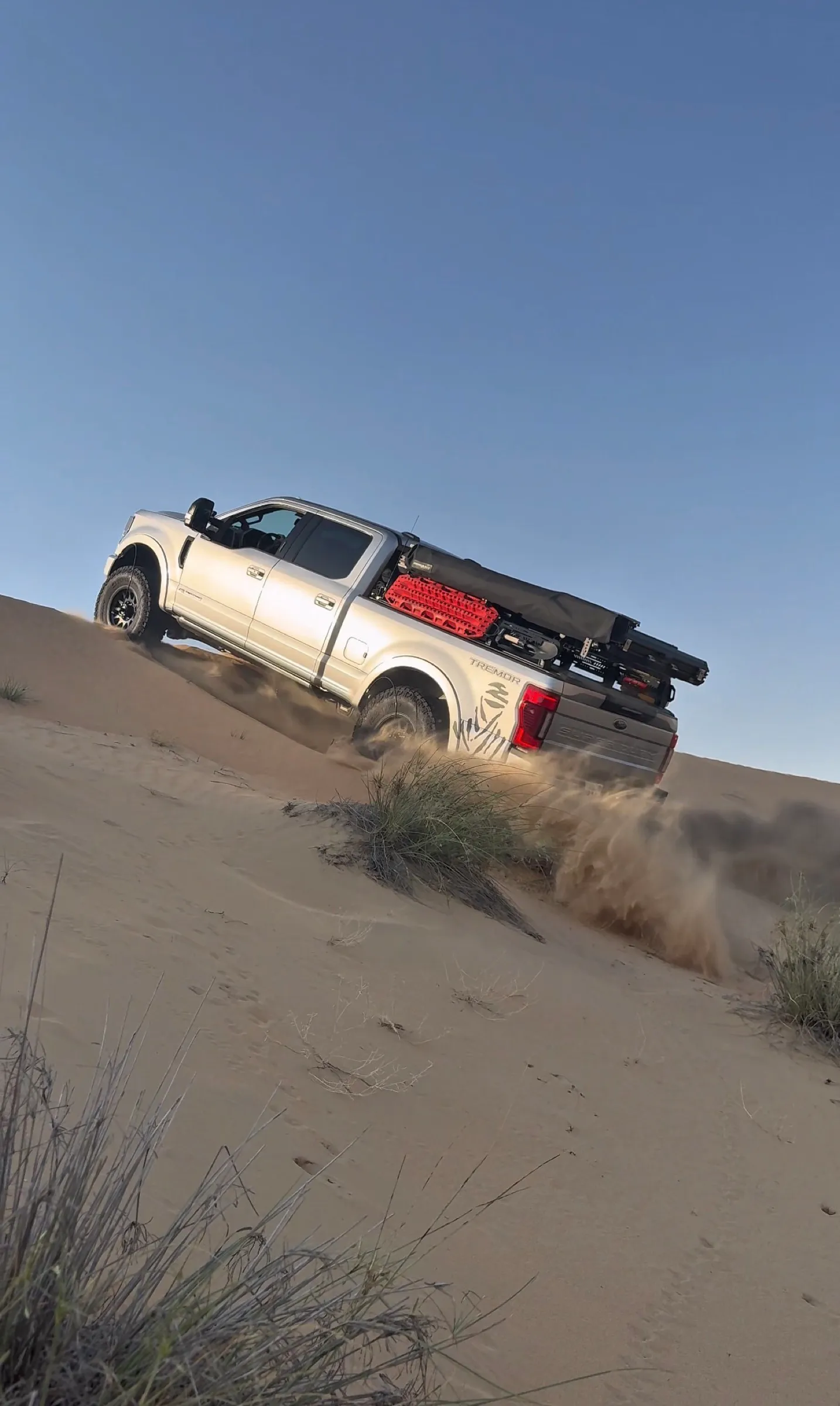
What’s the first thing to do when you get stuck?
Lift off the throttle. The moment the wheels spin freely instead of pulling the car forward, stop. A spinning wheel digs itself deeper. It smooths the sand into a bowl shape and drops the underside of the car onto the ground. That one reaction is the difference between a five-minute fix and an hour of digging.
Getting stuck is normal. Everyone who drives dunes gets stuck, and on its own it isn’t an emergency. It becomes one when people panic and try to power out.
With the engine idling, get out and walk around the car. There is one question to answer before you touch anything else.
Are you sitting low, or are you bellied?
Look at all four wheels, then at the underside of the car. If the tyres are buried but the underside is still clear of the sand, you have a grip problem. Lower tyre pressure and a bit of digging usually fix it. If the belly of the car is resting on sand, the sand is carrying the weight instead of the tyres. The wheels can have plenty of grip and you still won’t move.
Bellied cars have to be dug out from underneath first. Skip that and everything else you try is wasted effort.
How do you get out with no recovery gear?
Most of the time your hands and your tyre pressure are enough. Work in this order:
- Stop spinning. Still the most important step, and the easiest one to get wrong.
- Clear the belly if the chassis is grounded, until the car is sitting on its tyres again.
- Let the air out to 10 PSI. Stay slow at that pressure. Letting air out costs nothing, and it is the cheapest recovery tool you have. That longer footprint often gets the car straight out. See how to air down for the method.
- Clear the sand in front of every driven wheel. Hands, a floor mat, a flat piece of board. Shape a gentle ramp pointing the way you want to go.
- Take the weight out. Passengers step out of the car, and they can push. Reversing out along your own tracks works well, because that sand is already packed down.
- Steer left-right. A little gas and steer left-right, left-right in small, smooth movements: the tyres cut fresh sand and climb out of their ruts. Don’t floor it; wheelspin digs you deeper.
- Rock it free. Ease forward, then back, building a little more momentum each pass. Smooth throttle the whole time, never a stab.
No deflator? You can press the valve pin in with a key. Re-inflate before you drive back onto tarmac. Low pressure at road speed destroys tyres.
What if it isn’t a 4x4?
Most of the steps above work in any vehicle — the physics of a spinning wheel doesn’t care what badge is on the bonnet. But if you are in a saloon, a hatchback or a two-wheel-drive crossover, three things are different, and one of them changes what you should do first.
You will belly far sooner. A 4x4 rolls through a depth of sand that a low car simply sits down on. So the check in the section above matters more, not less: look under the car before you try anything. Once a low car is resting on its floor, more throttle achieves nothing at all.
Your driven wheels are probably your front wheels. On a front-wheel-drive car the wheels doing the pulling are also the ones doing the steering, so the small, smooth left-right steering works directly on the only wheels that pull. On a rear-wheel-drive saloon it is the other way round: steering doesn’t move the driven wheels, and they sit at the light end of the car.
You are almost certainly close to firm ground. This is the useful part. A 4x4 gets stuck in the middle of a dune field. A normal car gets stuck at the edge of the sand — a soft verge, a beach car park, the last few metres of a graded track. The way out is usually the way you came in.
So: reverse out along your own tracks. That sand is already compacted by your own wheels, and it is the shortest distance back to something firm. Driving forward to look for firmer ground is how a two-metre problem becomes a two-hour one.
Two more things specific to a normal car:
- Airing down works, with a catch you can’t ignore. The longer footprint helps any tyre. But a standard rim relies on air pressure alone to hold the tyre on, so the lower you go, the easier a sideways load pulls the tyre off the rim: drive slowly, with no sharp turns. And if you have no compressor in the boot, you are now on soft tyres a long way from a pump. Let out a modest amount, get free, and put the air back in at the first petrol station.
- Floor mats are the poor man’s traction boards. Wedge them under the driven wheels, pointing the way out, and ease on gently. Stand clear of the back of a driven wheel while someone else eases the car on — a mat that gets spun can come out hard and fast.
If a passing 4x4 offers a tow, slow down for a second. A light unibody car has very few points designed to take a recovery load. A tow ball is not one, and neither is a suspension arm or an eyelet meant for a workshop trolley. Bumpers, subframes and boot floors get pulled off cars this way every season. A flatbed recovery costs a great deal less than a subframe, and a bellied low car on sand is usually a flatbed job rather than a snatch job.
What recovery gear actually gets you out fastest?
Gear makes recovery faster. It does not replace the steps above.
| Method | What it fixes | Speed | Main risk |
|---|---|---|---|
| Letting more air out | Tyres cutting down into soft sand | Minutes | Forgetting to reinflate before the road |
| Digging by hand | Sand packed in front of the wheels | Slow and tiring | Heat, sweat, exhaustion |
| Folding shovel | Same, plus a bellied chassis | ~30 seconds instead of minutes | Almost none. It just saves effort |
| Traction boards | Driven wheels with nothing to grip | Frees most stuck cars | Spinning on them melts them and throws them out |
| Kinetic (snatch) strap | Almost anything, with a second vehicle | Fastest of all | The most dangerous option by far |
Traction boards go under the driven wheels, pointing the way out. Ease onto them with smooth low throttle and let the tyres climb. Do not spin the wheels on them. High RPM melts the surface and can throw the board out behind the car.
A folding shovel turns hand-digging into about thirty seconds of work. The first time you are bellied, you will be glad it is in the boot.
A kinetic strap pulled by another vehicle is the quickest fix. It is also the one that injures people. Use rated recovery points only. Never use a tow ball. Everyone must stand well clear of the line. If nobody has shown you how to do it properly, wait for someone who has.
What makes being stuck worse?
- Spinning the wheels. The worst one, and the one almost everybody does first.
- Trying to recover at full road pressure. If you got stuck on road PSI, that’s the cause. Air down before you try anything else.
- Holding the wheel turned while stuck. A wheel held at an angle pushes sand ahead of it and digs in. Steer left-right in small, smooth movements instead.
- Recovering while angry, tired or dehydrated. That’s when people skip the safety steps and get hurt. Water first, two minutes in the shade, then start work.
When should you stop and wait?
When you’ve aired down, dug out, tried boards and rocked the car and it’s still not moving, stop. Sit down, drink water, and wait for the rest of your convoy. This is exactly why the convoy rules exist. Going at a stuck car again and again in UAE summer heat drains your water and your judgement at the same time.
A stuck car with friends nearby is an inconvenience. A stuck car alone, in heat, is the start of a real emergency.
If the answer is that nobody is coming, this is how you get help to your exact position.