
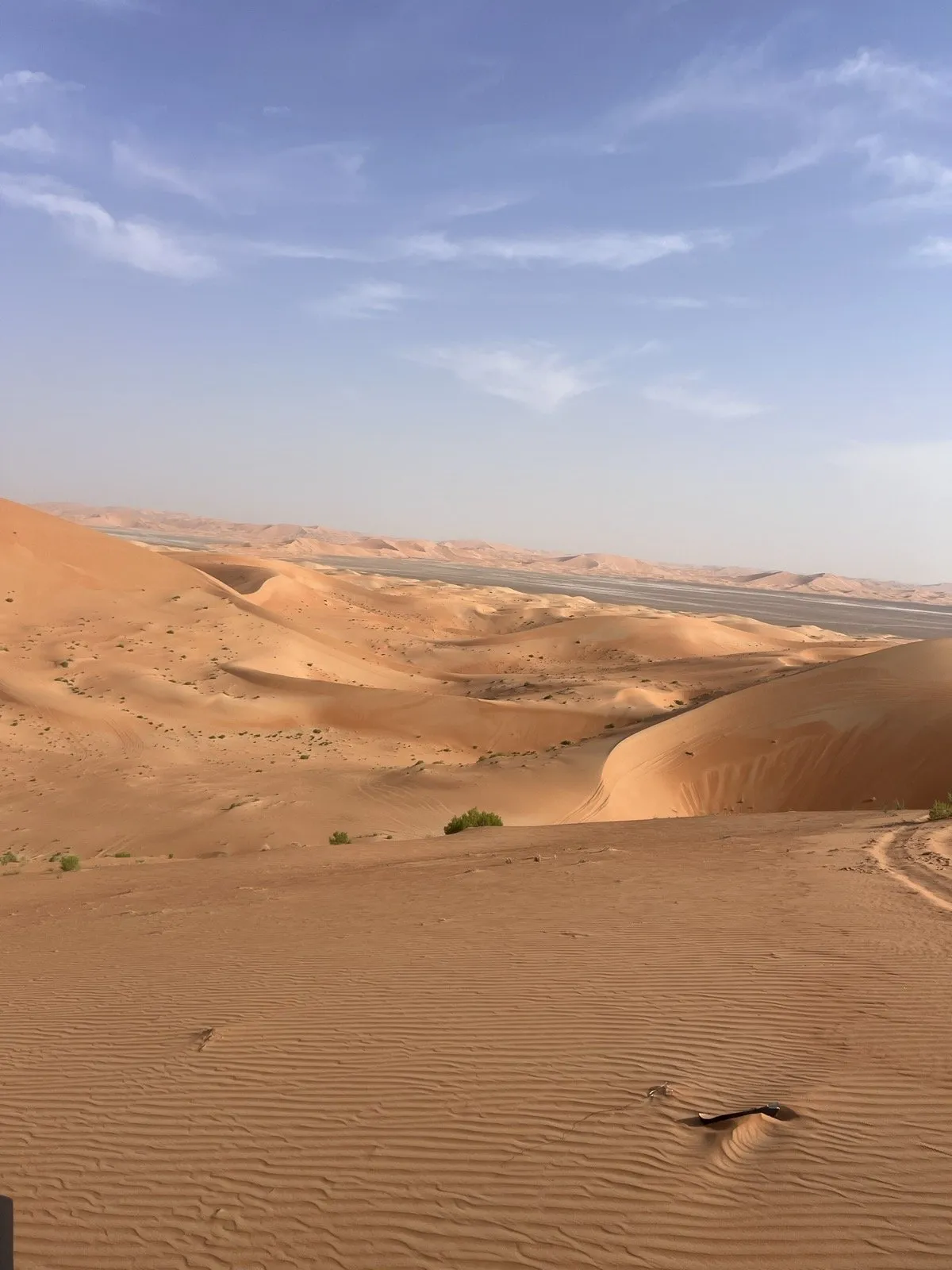
What is this place?
A patch of flat, dark desert in Abu Dhabi’s Al Ain Region whose fame rests on a Google Maps pin — “AL Quaa Milky way Spot” — that thousands of stargazers have navigated to. Nobody is credibly credited with creating the pin; it simply became the UAE’s default answer to “where can I actually see the Milky Way?”. An astrophotographer put the appeal plainly to The National: the south of this area is pitch black.
One honest caveat before the romance: no instrument reading backs the “darkest in the UAE” title — no published Bortle class, no sky-brightness measurement from a named source. The reputation is earned by results (see below), not measured. We print it that way.
Getting there
From Abu Dhabi: the E22 toward Al Ain, then south with the signs — about 125 km, 90 minutes. From Dubai: via Al Ain, 2–3 hours. The road is paved almost the whole way; the last stretch is packed sand that a carefully driven sedan handles. The landmark is a large roundabout — the famous pin sits just behind it. Drivers’ standing advice for sedans: stay in the middle of the track, keep moving straight, and never test the soft shoulders — that is where the tow ropes come out.
Al Quaa village is the anchor: its ADNOC (station 946, on the Umm Al Zamool road) is an old-style stop with petrol, air, water and an ATM, plus small supermarkets nearby. Fill up there regardless of your plan — westward the next fuel is Hameem, more than 150 km of desert away. The previous stop coming from Al Ain is Al Wagan, 36 km before Al Quaa.
The season, from the people who run the nights
The Dubai Astronomy Group — which has run organised Milky Way nights here, buses from Dubai included — puts the core season at late March through September, best between 9pm and 3am, with a new-moon night as the non-negotiable ingredient. The winter trade-off: October to April is the comfortable camping window, but the galactic core sits low.
What the sky here rewards: one photographer captured both the winter and summer Milky Way arches from a single tripod position in one night — the 9pm arch and the 3am arch, six hours apart. That image, not a measurement, is the place’s real credential.
Etiquette the regulars ask of newcomers, and worth repeating verbatim into your convoy chat: dim your headlights on approach, red lights only at the site, no flash, no bonfires on open sand, park on firm ground, and download offline maps — signal is patchy.
The dunes behind the viewing area
This page would be dishonest if it stopped at stargazing. Behind the sedan-friendly flat, the Al Wagan–Al Quaa dune belt is serious country: the OffroadPal entrance and camping pins there are Advanced-graded in the app, and the club reports explain why — dunes described at 150–200 m, and one documented bowl recovery that needed 30 metres of rope plus 30 metres of winch line. Off-road clubs have run night photography drives here precisely because the darkness is real; they did it in convoys, with equipment.
Two different trips share this page: a family stargazing night on the flat, and an Advanced dune day behind it. Know which one you are packing for. (And one name-trap from our own map: the app’s separate “Camping Al Quaa” pin sits about 55 km further southeast, deep on the border corridor — it is not this place.)
Also here: an official off-road route
DCT Abu Dhabi’s Umm Al Oush Route — one of the six official self-drive routes — is anchored “near Al Quo’a services”: 70–80 km, rated Advanced, 5–7 hours. The same village that anchors the UAE’s favourite dark sky anchors one of its official hard routes; that pairing tells you what this corridor is. Overlanders continuing west report the 28 km gatch section toward Hameem going soft after sandstorms, with oilfield trucks now using the corridor — and photography restrictions apply toward the Umm Al Zamool border side.
The honest footer
OffroadPal grades are indicative and spots are not inspected. Nothing on this page asserts that Al Quaa — the viewing area or the dunes — is safe. Closed shoes against snakes and scorpions is standard local advice; winter nights drop fast, and the sleeping-bag rule locals use is 5°C below the forecast. Tell someone your plan, keep the car on firm ground, and let the sky do the dramatic part. The app carries the entrance pins, the camping pin, and the honest distances between fuel.