
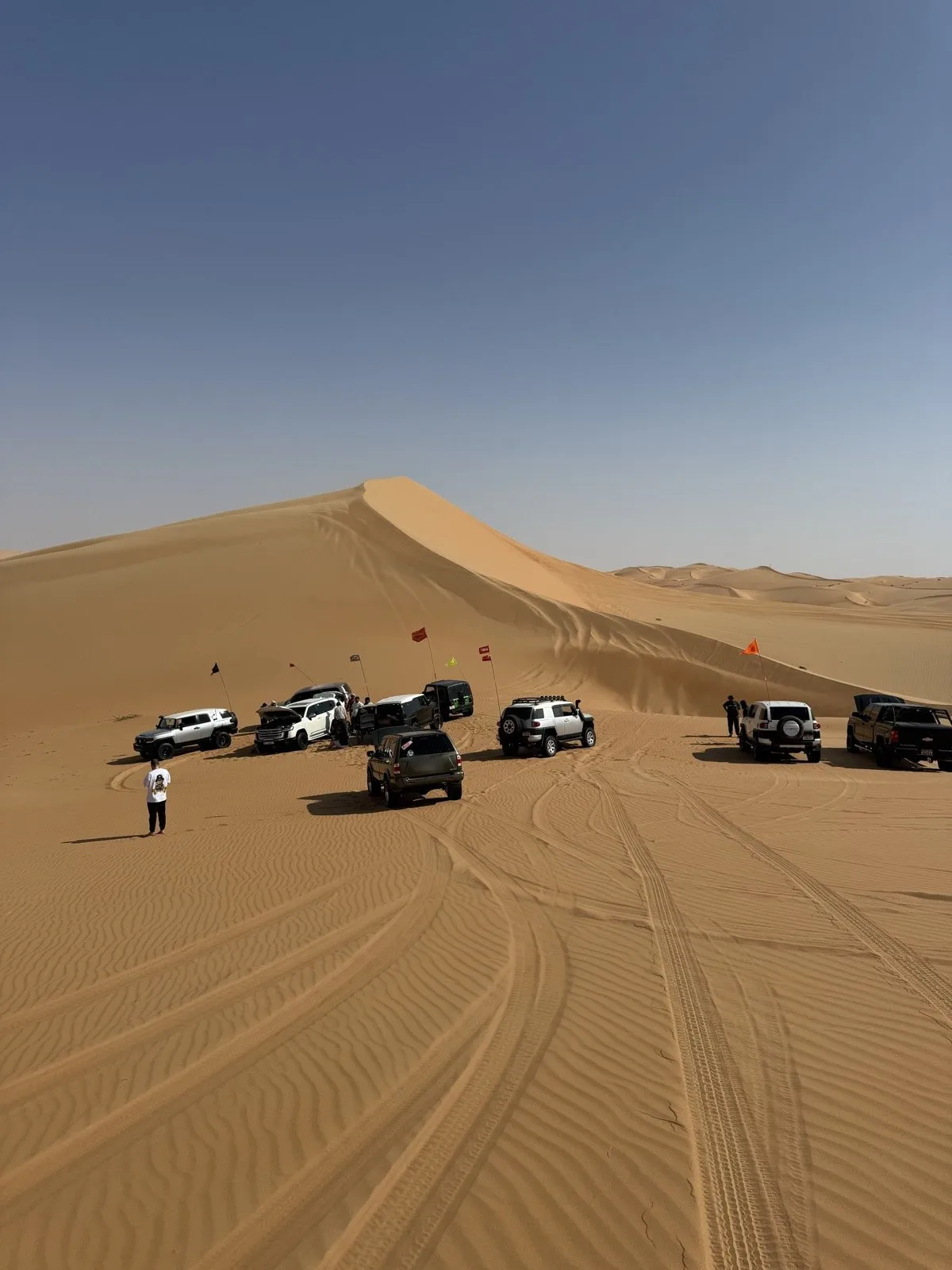
What is Liwa?
A crescent-shaped arc of some fifty villages, about 100 km end to end, strung along the northern edge of the Rub’ al Khali — the Empty Quarter, roughly 650,000 km² of connected sand across four countries, the largest contiguous sand desert on Earth. Liwa is the last inhabited line before it. Mezaira’a (increasingly signposted as Liwa City) is the hub where the road from Abu Dhabi meets the crescent: 45 km of arc to the west ends at Arada, 65 km to the east runs toward Hameem.
By road it is about 240 km from Abu Dhabi — E11 to Tarif, then E45 south through Madinat Zayed — call it 2.5 to 3 hours. History note that explains the region’s weight: in 1793 the Al Nahyan family moved their seat from Liwa to Abu Dhabi. The emirate’s story starts here, among the date farms. Hollywood knows the dunes too — Star Wars: The Force Awakens and both recent Dune films shot here.
Why Liwa is a different category
Every northern dune field on this site shares one property: tarmac is minutes away. Liwa’s defining fact is that it is not.
- The official route: DCT Abu Dhabi’s “Liwa Crossing” — 109 km, rated Advanced by DCT itself, planned as 1.5–2 days with camping. It runs west-to-east from near Arada, past salt pools and the Qasr Al Sarab area, exiting onto the Hameem-side tracks. We re-verified the official route map the day this page was written; its own waypoints include the warning “Stay on gatch track — do not use oilfield road.”
- No early exits: clubs brief their crossings as 100–150 km of committed driving — once in, you finish or you turn the convoy around. Dunes on the crossings are reported at 200–300 m with the longest side-slopes in the country.
- The fuel maths: a documented club requirement — 100–120 L (6-cyl) / 120–140 L (8-cyl), full at the start, jerry cans included. Last fuel depends on your entry: Mezaira’a’s ADNOC (977) before Moreeb, Khanoor (832) on the eastern crescent, Hameem’s station at the far end.
- Comms: drivers report no phone signal in the deep sand — handheld radio between cars, satellite messengers for the remote legs.
- Convoy norms, as drivers report them: minimum three cars, most clubs run five to ten, all experienced, with lead and sweep roles and radio discipline. One documented club prerequisite for a crossing: five prior club drives in the preceding three months.
None of that is our rating. It is what the authority that published the route and the clubs that drive it require of themselves — which tells you more than any grade chip could.
What a normal visitor can do
Plenty, on pavement. The crescent villages, the date farms (the Liwa Dates Festival runs every July in Mezaira’a), the forts, Tal Moreeb’s base via its own paved road, and the December festival. Qasr Al Sarab, the landmark desert resort on the eastern side, adjoins the 308 km² Qasr Al Sarab Protected Area (area per the federal ecotourism register). The Environment Agency – Abu Dhabi describes the reserve only as adjacent to the hotel and publishes no self-drive access route into it — we found no permission to drive it, so do not plan to. Family-accessible sand exists at the crescent’s edges off the gatch tracks — drivers report the Arada south-east slipfaces over the salt flats as the classic viewpoint run.
And a freshness note worth planning around: Etihad Rail’s Liwa and Madinat Zayed passenger stations open 30 November 2026 — moved forward a month to catch the festival season. The Empty Quarter’s gateway is about to have a train.
When to go
October to April, without negotiation. Al Dhafra posts the country’s hottest readings nearly every summer — 51.2°C on 5 August 2026 was the UAE’s peak so far this year, recorded in this region. Winter desert nights at the crescent get genuinely cold; drivers pack for both ends.
The honest footer
OffroadPal grades are indicative and spots are not inspected. Nothing on this page asserts that Liwa is safe — the whole page is an argument that it demands more than the northern fields, and the app lists our Liwa pins accordingly. If your dune hours were built at Al Qudra and Sweihan, the crossing is not your next drive; joining an experienced convoy is. The app carries the entrance pins, the festival-season notes, and everything between here and the border.