
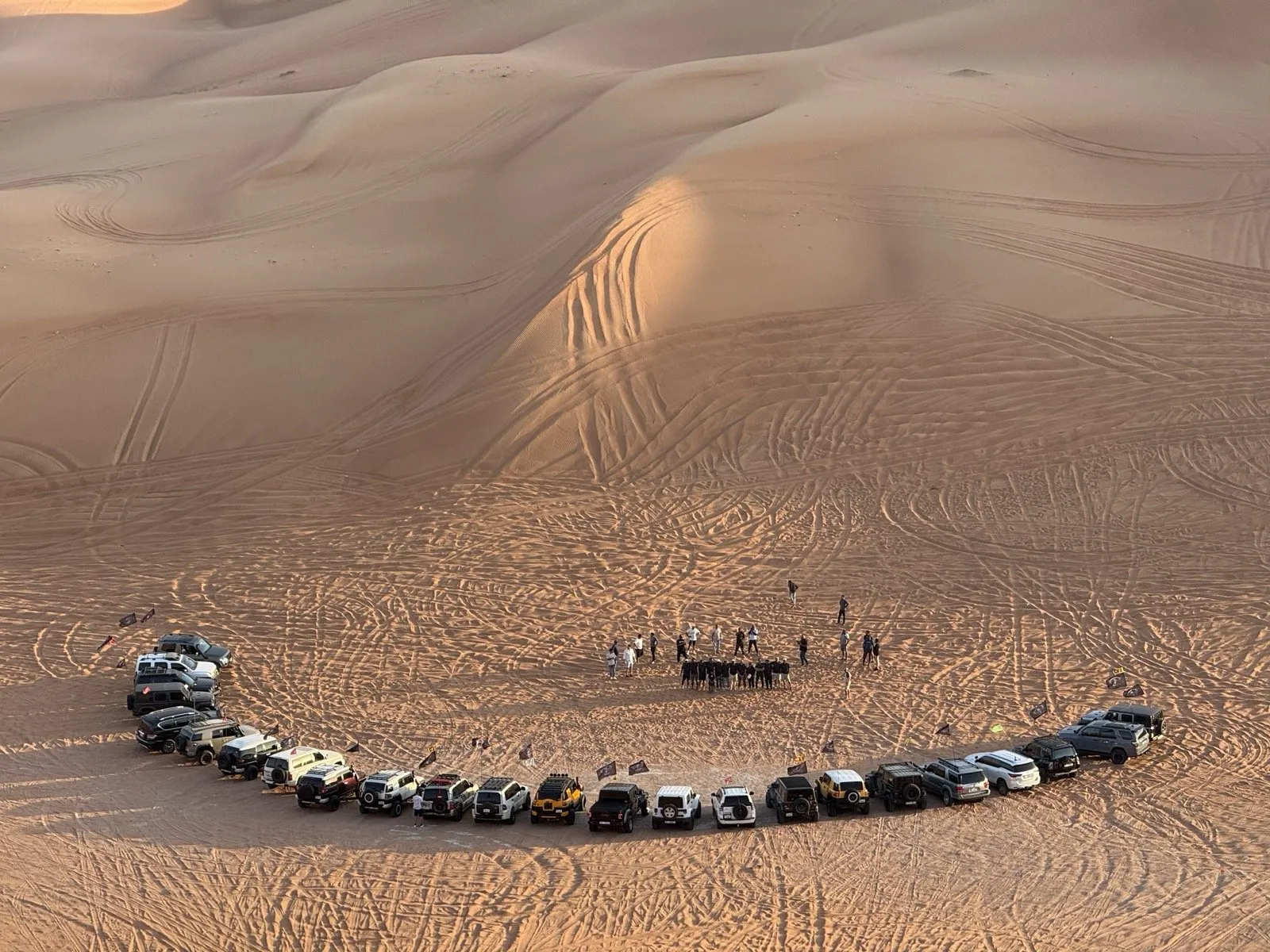
How does a desert convoy actually work?
A convoy is a fixed order of cars with a specific job at each end. The lead car chooses the route and sets the pace. The sweep car drives last and checks that every car is still there. Everyone in between holds their position, keeps their spacing, and stays on the radio.
That structure is the whole point. It is what lets a group get a stuck car moving again without anyone being left behind. A convoy is not just a few cars driving together. Once you understand the roles, you stop being the person who accidentally causes the problem.
Who does what in the line?
Three positions, three different jobs.
| Position | What they do | What goes wrong without it |
|---|---|---|
| Lead | Chooses the route, sets the pace, warns about hazards and route changes on the radio | The group follows a route it can’t drive, or the group drives faster than the slowest car can manage |
| Middle cars | Hold order and spacing, relay radio calls forward and back | Gaps open up, cars overtake where they can’t see ahead, drivers start choosing their own routes |
| Sweep (last car) | Checks that nobody drops out, whether broken, stuck or lost | A missing car isn’t noticed for 20 minutes. By then it’s catastrophic |
The two ends matter most. If a car drops out, it is the sweep’s job to notice immediately, not 20 minutes later. Agree both roles out loud before you start driving on sand, so every driver knows who is leading and who is counting cars.
Why do convoys use radios instead of phones?
Because you cannot rely on a phone out there: coverage near the popular dune areas is often usable, but it drops in bowls, between big dunes and off-track. A licence-free PMR446 handheld radio per car, on a single agreed channel, is the basic kit for any group drive. (Other VHF/UHF radios need a TDRA licence.)
- Test the channel before you air down, while everyone is still parked together.
- The lead announces route changes and hazards. For example: “Sharp left coming up, soft pocket on the right.”
- Anyone stuck radios immediately. Don’t spend ten minutes trying alone.
- Keep transmissions short. The whole convoy hears every word, and long stories block the channel.
- Agree what happens if a radio dies: stop, stay visible, don’t wander off looking for signal.
How much space should you leave between cars?
Roughly 50 metres on open dunes, and much closer on tight technical sections. The number comes from a simple rule. Stay close enough to see the car in front clearly, and far enough back that you don’t run into it if it stops suddenly.
Two things go with spacing. First, match the convoy’s pace. Don’t rush past slower drivers, and don’t leave them behind by going too fast. Second, never stop where you can’t be seen. A car parked just under a crest, or sitting at the bottom of a bowl, is invisible to whoever comes over next. If you have to stop, roll to a spot where other drivers can see you from a distance.
What do you do when someone gets stuck?
Getting stuck is normal in sand. Handling it badly is what turns a ten-minute delay into a lost afternoon. Here is the sequence:
- The stuck driver radios it in the moment they know they’re not driving out of it.
- Everyone behind stops in a safe spot and waits. Open ground where they can be seen. Not on a crest, not in a bowl.
- The car immediately ahead and the sweep deal with the recovery. They’re the two vehicles best placed to reach it.
- Everyone else stays out of the way unless more help is asked for. Extra cars driving around the scene are extra cars to keep track of.
- Nobody films instead of helping. Do the recovery first.
- The sweep confirms the full count is back together before the lead moves off again.
What do beginners get wrong most often?
Almost always one of four things:
- Saying nothing. If you’re struggling, say so early. If you stay quiet, everyone ahead assumes you’re fine.
- Overtaking. Passing a slower driver breaks the order and puts you on a route the lead didn’t choose.
- Leaving the group without telling anyone. If you drive off without a radio call, even for a short time, the group will start searching for you.
- Assuming someone noticed. Only the sweep is actually counting. Everyone else is watching the sand.
How does the OffroadPal Convoy feature fit in?
It gives the group a shared live map. Open the map, tap Convoy, and you share your live location with the group, see everyone’s position, and can trigger an SOS that pings every member if you’re in trouble.
Use it alongside a handheld radio, not instead of one. The app tells the group where you are. The radio tells them what’s happening.
The one thing to remember
Know your position in the line and hold it. The lead sets the pace. The sweep counts the cars. Everyone else stays where they’re supposed to be and speaks up when something changes. That’s the whole discipline.