
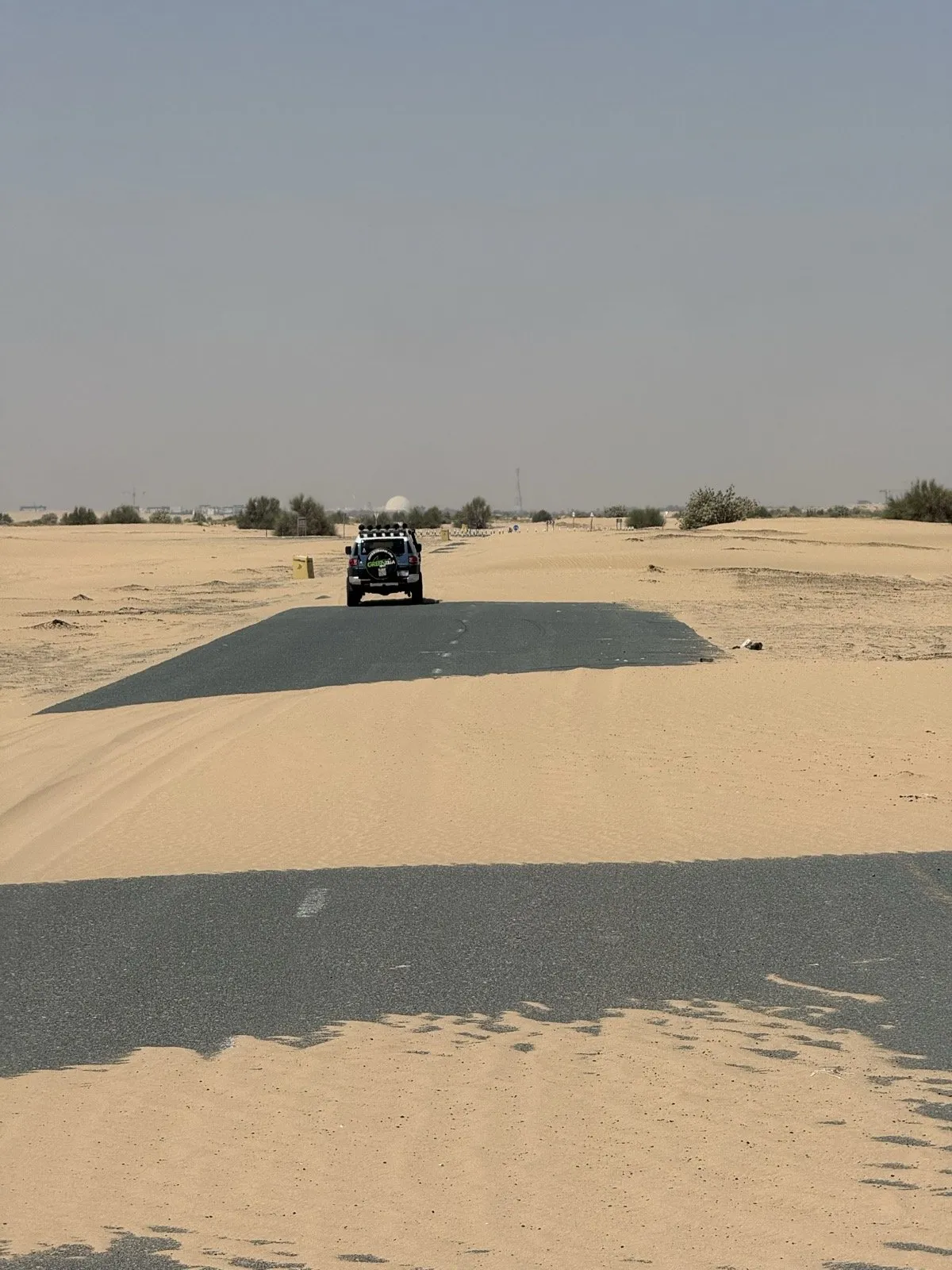
When is it too hot to drive the desert?
Roughly mid-May through September, during daylight hours. The National Centre of Meteorology puts July’s average maximum at 39.7–43.8 °C nationally — but that is the national average, and the inland stations nearest the dunes run far hotter. NCM logged 50.4 °C at Sweihan and 50.3 °C at Mezaira’a on July afternoons in 2025. Assume the dune field is hotter than the forecast you read for the city.
The heat isn’t dangerous because of the driving. It’s dangerous because of what happens when the drive goes wrong. A stuck vehicle in July is a completely different problem from a stuck vehicle in January. Getting it out is hard physical work. The sand throws heat back at you. Open dunes have no shade at all. Heat illness becomes a medical emergency in minutes, not hours.
Which months do people off-road in the UAE, and which do they avoid?
Here’s the year, from a driver’s point of view.
| Window | What it is | How to treat it |
|---|---|---|
| October – April | The season | Best time to learn. Comfortable temperatures, busy trails, lowest heat risk. |
| May & September | Between seasons | Early morning or dusk only. Keep drives short. |
| June – August | Peak summer | Sunrise or dusk runs only, in a group. Midday is off-limits. |
| Any rain event | Don’t go | Wait until well after it dries. See below. |
| Sandstorm / low visibility | Don’t go | Turn back if you’re already out. |
The pattern is simple. The time of year decides how much room for error you have, and summer takes away almost all of it.
Can you off-road in summer at all?
Yes, but only early in the morning or late in the day. Keep the trip shorter and simpler than a winter one. If you’re going out between June and August:
- Drive early or late. Just after sunrise, or late afternoon into dusk. Avoid roughly 11am to 4pm entirely.
- Carry far more water than feels necessary. Whatever number sounds reasonable, take more.
- Tell someone your plan. Say where you’re going and when you expect to be back.
- Keep it short and close to a road you can get out on. Deep-desert exploring is a winter activity.
- Go in a group. In summer the desert is at its emptiest, so there are fewer strangers around to help. Your group is what gets you out.
Why is rain the most dangerous condition here?
Because the ground can’t absorb it. The UAE gets little rain, but when it comes it arrives fast. The water funnels into wadis and low desert ground with very little warning. No UAE authority publishes a breakdown of weather deaths by cause, so we can point at cases rather than a percentage — and the cases are enough. Ras Al Khaimah Police confirmed a man in his 70s died on 16 April 2024 when his vehicle was swept away crossing a flooded wadi, and the July 2022 floods across Fujairah, Ras Al Khaimah and Sharjah killed seven people.
Two things catch people out:
- A wadi stays dangerous after the sky clears. The water reaching your crossing can come from rain that fell kilometres upstream, long after it stopped where you’re standing. Clear sky above you tells you nothing about what’s coming down the channel.
- Wet sand can fool you. It can feel firm when you walk on it, then give way under the weight of a vehicle.
Never enter a flowing wadi. After rain, wait a day or more before driving wadi or low-lying routes. A few hours is not enough. When authorities issue weather warnings or close roads, that’s not advice. Follow it.
What should you do in a sandstorm?
Turn back the moment blowing sand stops you seeing the terrain ahead clearly, or stops you keeping your group in sight. Shamal winds arrive fast and do two dangerous things at once. They hide the dune shapes and soft spots you’d normally read. They also make it easy to lose your convoy.
If it catches you out there:
- Stop in a safe spot, off any crest or slip face.
- Hazard lights on.
- Stay together. Don’t let vehicles wander looking for the way out.
- Wait until it passes. Driving dunes you can’t see is how a bad day turns into a rescue call.
What makes a “good” day a bad day to go?
Perfect weather doesn’t make a trip safe on its own. These are the conditions that should stop you even in January:
| Red flag | Why it matters |
|---|---|
| Going alone | Driving the desert in one vehicle makes every other risk worse. |
| Nobody knows your plan | A small problem quietly becomes a serious one. |
| Late start, not enough daylight left | Getting stuck near sunset means recovering in the dark. |
| Vehicle or kit not ready | Low fuel, no recovery gear, not enough water. |
| Tired, rushed, or pressured to keep up | Most bad dune decisions come from pride or tiredness, not the terrain. |
That last one is worth thinking about. Terrain is predictable. People under pressure from the group are not.
The one thing to remember
Bad luck causes far fewer problems out here than bad timing and going alone. The drivers who keep doing this for years aren’t the ones with the most expensive trucks. They’re the ones willing to cancel and go next weekend instead.