
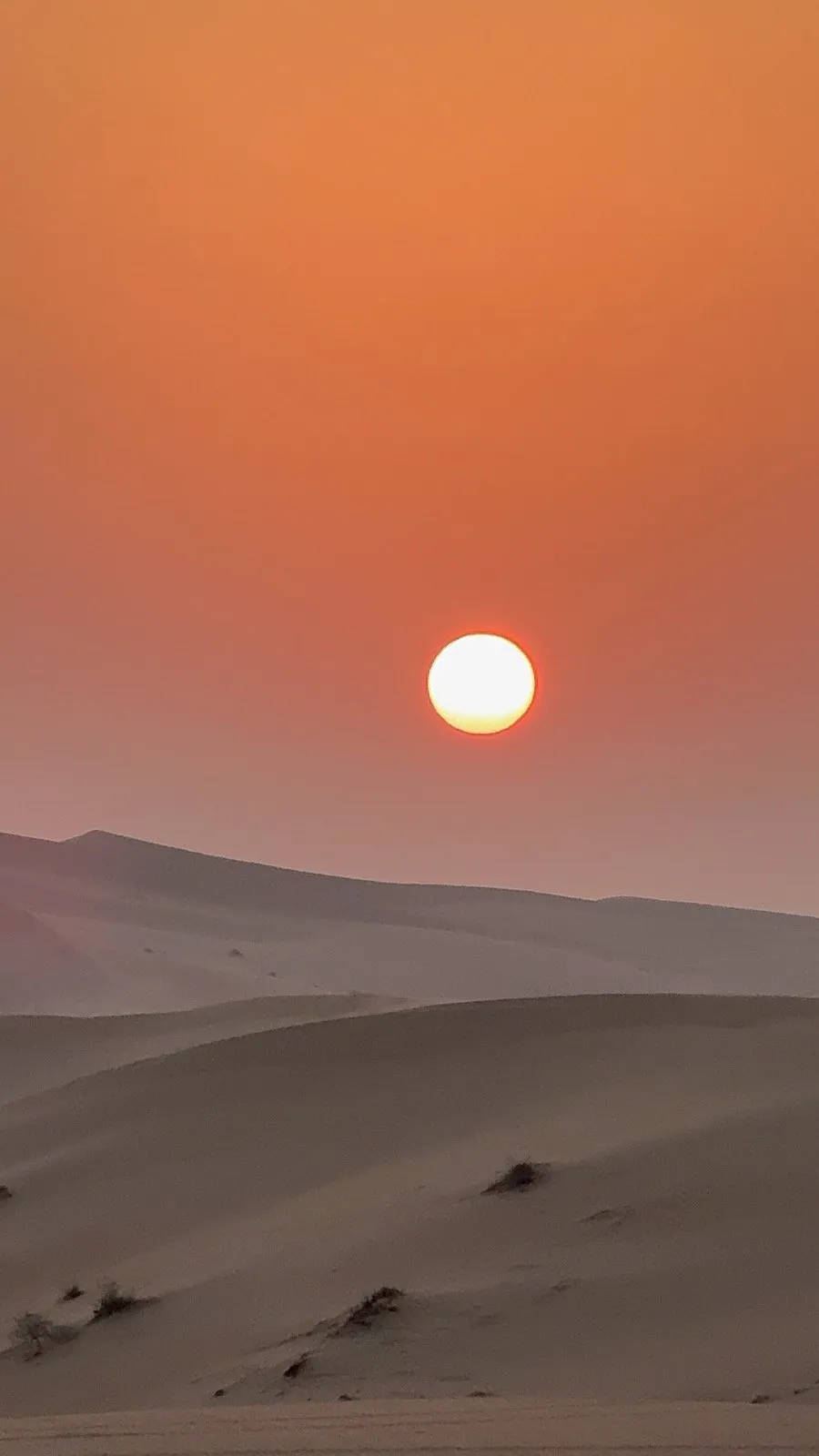
Why does heat catch off-roaders out?
Because you can’t see it coming. You can look at a dune and judge it. Heat builds inside you quietly, while you’re having a good day. Most desert emergencies in the UAE aren’t dramatic rollovers. They’re dehydration and heat exhaustion that crept up on someone who felt fine an hour earlier. In a UAE summer the desert can hit the high 40s °C, and heat illness can make a healthy person collapse in under an hour.
The car is what fools you. Your 4×4 has air conditioning. Your body doesn’t. Every time you step out (to air down, to dig a tyre free, to take photos on a ridge), the heat starts working on you. Digging is the worst of it. It’s hard physical work in full sun, usually at the exact moment the group is stressed and nobody is thinking about water.
Two things make it worse here than the temperature alone suggests. Pale sand bounces sunlight straight back at you, so the heat hits you from below as well as above. Near the coast the humidity is also high, so sweat evaporates slowly. Sweating is the main way your body gets rid of heat, and it works worst exactly when you need it most.
When do people drive in the UAE desert?
Timing is the thing you control most, and for part of the year the honest answer is that midday isn’t safe at all.
| Period | Verdict | Main season |
|---|---|---|
| October–April | The real desert season | Most of the day. Still avoid peak midday |
| May–September | Genuinely dangerous by day | Dawn or late afternoon only. Never midday |
| Extreme-heat forecast | Don’t go | No spot is worth it |
All year round, the heat risk is lowest early morning and in the hour before sunset. Midday sun plus heat reflected off the sand builds up fast, and that’s when a routine stuck turns into a real problem. This applies on the easy tracks at Al Qudra just as much as on the dunes at Al Badayer. The heat doesn’t care how hard the driving is. Plan the hard driving for the cooler hours, and leave spare time in your plan. A recovery always takes longer than you expect.
How much water should I bring?
More than you think you need, and you should be drinking before you feel thirsty.
- Carry several litres per person per day, and more when it’s hot. Add a spare jerrycan for the group. Somebody always underestimates.
- Sip steadily from the start. Thirst means you’re already short of water, not that you’re about to be.
- Add electrolytes or rehydration salts on hot days. Plain water alone doesn’t replace what heavy sweating takes out of you.
- Keep water reachable in the cabin, not buried in a hot boot behind the recovery gear. Water you have to unpack for is water you won’t drink.
- Count the passengers, not the cars. Kids and anyone new to the climate heat up faster than the driver does.
What are the early signs of dehydration?
Headache, dizziness, dark urine, irritability and unusual tiredness. That’s the stage where you want to catch it. Someone getting short-tempered over nothing is a real warning sign, not just a mood. Judgement fails before the body does. At this point the fix is simple. Drink, get into shade or the AC, and rest until they feel right. Keep going instead and you’re heading for what’s in the table below.
Heat exhaustion or heat stroke: how do you tell?
The difference that matters is sweating. In heat exhaustion the body is coping badly. In heat stroke the body has stopped coping, and what you do about it is completely different.
| Heat exhaustion | Heat stroke (emergency) | |
|---|---|---|
| Skin | Heavy sweating, cool and clammy | Hot and DRY. Sweating has stopped |
| Mental state | Weak, tired, nauseous | Confused, slurred speech, may collapse |
| Body temp | Raised | Soaring |
| What to do | Stop, shade or AC, water with electrolytes, cool down, rest. Usually recovers | Life-threatening. Call emergency services now, cool aggressively, don’t wait |
When sweating stops, treat it as an emergency. It means the body has stopped coping. It does not mean the person is cooling down. This is the easiest warning sign to misread, because someone who has stopped sweating can look calmer than someone soaked in sweat.
What do you do if someone collapses?
- Get them into shade or the AC car straight away.
- Cool aggressively. Water on the skin, fan them, remove excess clothing.
- Hydrate if they’re conscious. Water with electrolytes, small sips.
- If you see heat-stroke signs (hot dry skin, confusion), call emergency services immediately. Don’t wait to see whether they improve.
Save the emergency number in your phone before you leave, and know roughly where you are. The nearest named landmark or track entrance is far more use to a dispatcher than “somewhere in the desert.”
What should you never skip?
- Never go alone in serious heat. Drive in a convoy, and make sure someone not on the trip knows your route and your return time. OffroadPal’s convoy and SOS features exist for exactly this.
- Keep shade or AC close by. The car is your shelter. Don’t walk far from it in heat, and don’t sit in it with the engine off. A parked car heats up fast inside.
- Phone charged, plus a backup way to call. Signal drops out in a lot of places. Offline maps and SOS help, but have a second option.
- Cover up and use sunscreen. Long sleeves, a hat and a wet buff on the neck really do cool you down. Bare skin in direct sun feels cooler, but it makes you hotter.
The one thing to remember
The desert doesn’t feel dangerous until it suddenly is. Go at the right time, carry more water than the trip should need, and never go alone. Do those three things and most of the risk is gone before you even air down.