
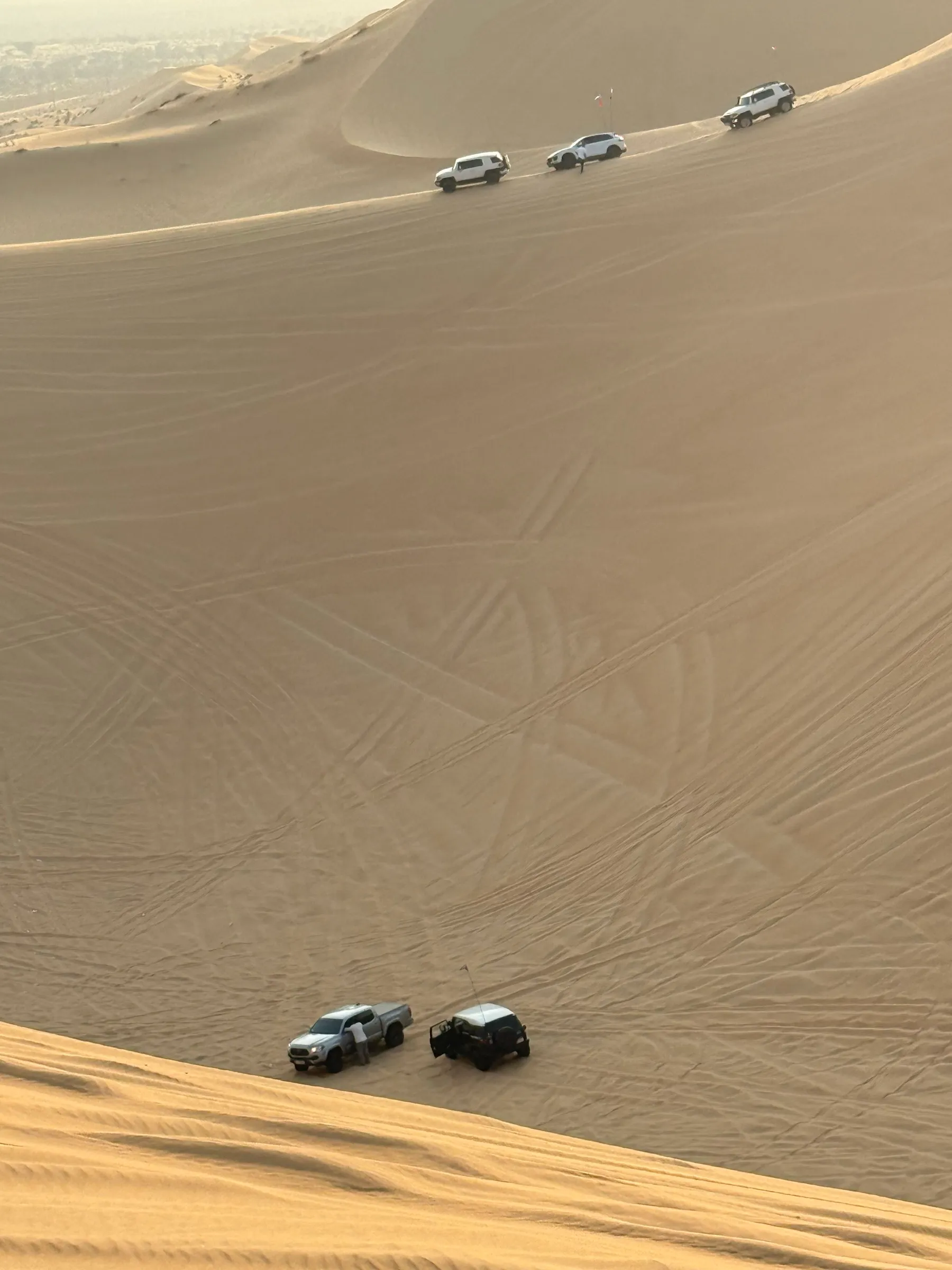
Why doesn’t everyone run the same tyre pressure?
Because weight decides the number, and a Patrol weighs far more than a Wrangler. Pressure is just air holding up the car, so the heavier the vehicle, the harder it squashes the tyre at any given PSI. Two cars set to the same pressure end up with completely different amounts of sidewall bulge. One floats nicely. On the other, the tyre is about to roll off the rim.
That is why this page has no table of pressures. A pressure that works on a friend’s Wrangler can roll a tyre off a Patrol’s rim, and no factory manual lists a dune figure. Your number starts from your car’s weight and your own road pressure, and a course gives you the one that fits your car.
What pressure should my vehicle start at?
At its own road pressure, then down in small steps. Where you stop depends on weight, and weight is the one thing you can look up:
| Vehicle | Rough weight | What it means for your pressure |
|---|---|---|
| Nissan Patrol, Land Cruiser 200/300, Lexus LX | ~2,600-2,900 kg | Needs the most air of the common 4x4s |
| Prado, Pajero | ~2,200-2,500 kg | In the middle, and the most forgiving to learn in |
| Fortuner and similar mid-size | ~2,100-2,300 kg | In the middle |
| Jeep Wrangler | ~1,900-2,100 kg | Can go lower than the heavy ones |
| Any of the above, heavily loaded | — | Behaves like a heavier car: add a little air |
The Prado and Pajero row is what most UAE beginners drive. The top row catches people out most often. Drivers see a friend on a Wrangler running low, copy the number on a 2,800 kg Patrol, and lose a tyre off the rim on the first hard turn.
Wide tyres change things slightly too. A wide footprint already spreads weight over more sand, so a vehicle on wide tyres sometimes doesn’t need to go as low as its weight bracket suggests.
How do I set my pressure on the day?
Do it at the edge of the sand, before you drive in, on flat ground.
- Write down your road pressure first. The sticker inside the driver’s door jamb lists your exact vehicle’s numbers. Note it before you let any air out. You need it for the drive home.
- Let air out in small, even steps, not big jumps. Small changes make a bigger difference than beginners expect, and heavier cars stop sooner.
- Check every tyre with a gauge. Matching all four matters as much as the exact figure.
- Test on the sand. If the car still digs in, let out a little more. If it floats, stop and write the number down. Your number for your car is what a course gives you.
- Drive gently while you’re flat. No hard, fast turns. That combination is what rolls a tyre off the rim.
- Re-check midday. Heat raises the pressure inside a tyre as you drive, so a tyre set in the morning can read higher a few hours later.
Doing this four times per stop is the tedious part. A multi-valve system like the Greenzilla 4in1 hooks up to all four tyres at once and equalises them, which removes the “one corner reads differently” problem entirely.
Does summer sand need a different pressure than winter?
Usually a little lower in summer. Hot, dry, fine dune sand behaves softer, so drivers often air down a touch further to float on it. Cooler winter sand tends to pack firmer and is more forgiving, so a little more air is often enough.
Inside the tyre, heat works the other way. The air expands as you drive, so your gauge reads higher through the day even if you touched nothing. Check again after an hour or two rather than trusting the number you set at sunrise.
How low is too low?
Below a certain point the tyre simply rolls off the rim. Heavy vehicles reach that danger point at a higher pressure than light ones, which is exactly why one universal number doesn’t work. Go low only with experience and a compressor already in the car.
Here’s the important part. If you’re already at your target pressure and still getting stuck, letting out more air is the wrong fix. The answer is a better line, more momentum, or a different approach angle. Keep letting air out and an easy recovery turns into a tyre off the rim far from help.
What do I air back up to before the road?
Your door-jamb road pressure. It is genuinely different between cars, so read your own sticker; do not use anyone else’s number. Do it before you touch tarmac. Tyres left at sand pressure flex constantly at road speed, build heat and can fail. The heavier your vehicle, the faster that goes wrong. Beginners skip this step when they’re tired at the end of a day, and it’s the step that causes blowouts on the drive home.
Carry a compressor. Never count on a shop being open at the edge of the sand.