
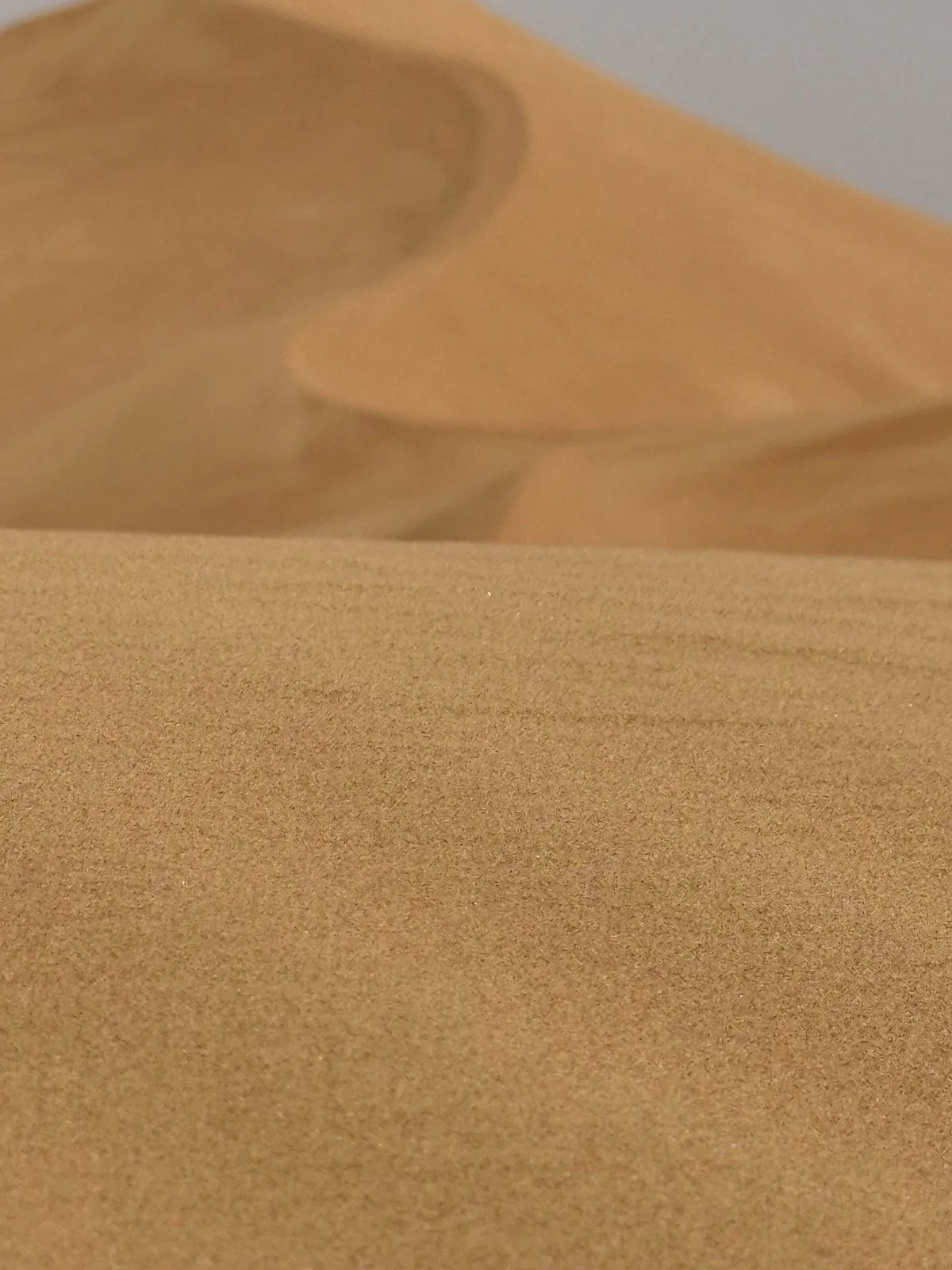
Rust on glass beads
Desert sand is mostly quartz, and quartz is colourless. The red is an extremely thin film of iron oxide on the outside of each grain — chemically the rust family — and, importantly, it forms after the sand is deposited rather than being inherited from the rock the grains eroded out of. You are driving on rusted glass beads.
Which oxide decides the shade. Hematite is what makes sand read genuinely red; goethite and less crystalline iron forms give the yellow-browns. The film is far thinner than paint. Billions of coated grains together are what you photograph at Big Red.
The colour map is mineralogy, not lighting
Drive inland from the Gulf coast and the ground changes colour. That gradient is real, and it is a change of material:
- The coast is not quartz sand at all. The British Geological Survey’s survey of the UAE describes the Gulf coast dunes as pale beige carbonate sand — marine in origin, built from shell debris and ooids off the shallow Gulf floor, with quartz making up only about a tenth of it. Carbonate has little iron to oxidise, so it never reddens. That is why the near-coast dunes look bleached.
- Inland is quartz-dominated — but not pure. Published petrography of the Liwa megadunes puts quartz first, with feldspar and rock fragments each above a tenth of the grains. It is those quartz grains that carry the iron coatings, and it is why the reds deepen as you go in.
Myth one: “redder means older”
This is the line every article reaches for, and it does not survive contact with the literature.
The foundational study — Walker’s 1979 work on dune sand, part of the global sand-seas survey — did find reddening increasing with age and with distance travelled. But the same work named several other controls, and they vary enormously from place to place: how much iron the source rock supplies in the first place, how much clay coats the grains, how much moisture is available (fog, dew, humidity all matter), and how long a dune has sat still rather than being churned and re-sorted. A 2012 study put the question in its title — do dune sands redden with age? — and the honest reading is that colour is not a dependable clock.
So: age contributes. Age does not decide. A pale dune is not necessarily young, and a deep red one is not necessarily ancient.
Myth two: “you can read the sand by its colour”
The driver’s-lore version says pale sand drives soft and fluffy, red drives firmer — or the reverse, depending who is telling it. We went looking for evidence and found none: no published study relates the hue of desert sand to how a vehicle crosses it. The engineering models that predict whether ground will carry a vehicle are built on moisture content, density, grain size and gradation. Colour is not a term in any of them.
What is solid physics is the moisture part: damp sand is firmer, because water binds the grains — which is why winter mornings after a humid night drive better than a bone-dry afternoon, everywhere, regardless of colour.
The reliable instrument is the one you already have. Look at your own tracks: shallow and crisp means the sand is carrying you, deep and collapsing means it is not. The physics page explains why that reading is the one that matters.
And the light really does lie
One thing the folklore gets right: the same Lahbab dune reads dull beige at noon and molten red at half past five. Low sun travels through more atmosphere, the blue end scatters away, and the iron oxide’s reds are what is left to bounce back at you. Midday sun flattens everything.
The grains never changed. Which is also why every desert-safari brochure was shot within an hour of sunset.
The honest footer
Sources checked in August 2026: the iron-oxide mechanism and its controls from the foundational sand-seas literature and a 2012 study testing the age relationship directly, the UAE coastal-versus- inland mineralogy from the British Geological Survey’s survey of the country, and the bearing-capacity point from published engineering work on sandy ground. Where we found no evidence — the colour-to-firmness link — we say we found none, rather than repeating the lore. Nothing on this page changes how anything drives: it explains what you are looking at, and the ground still has to be read one track at a time.