
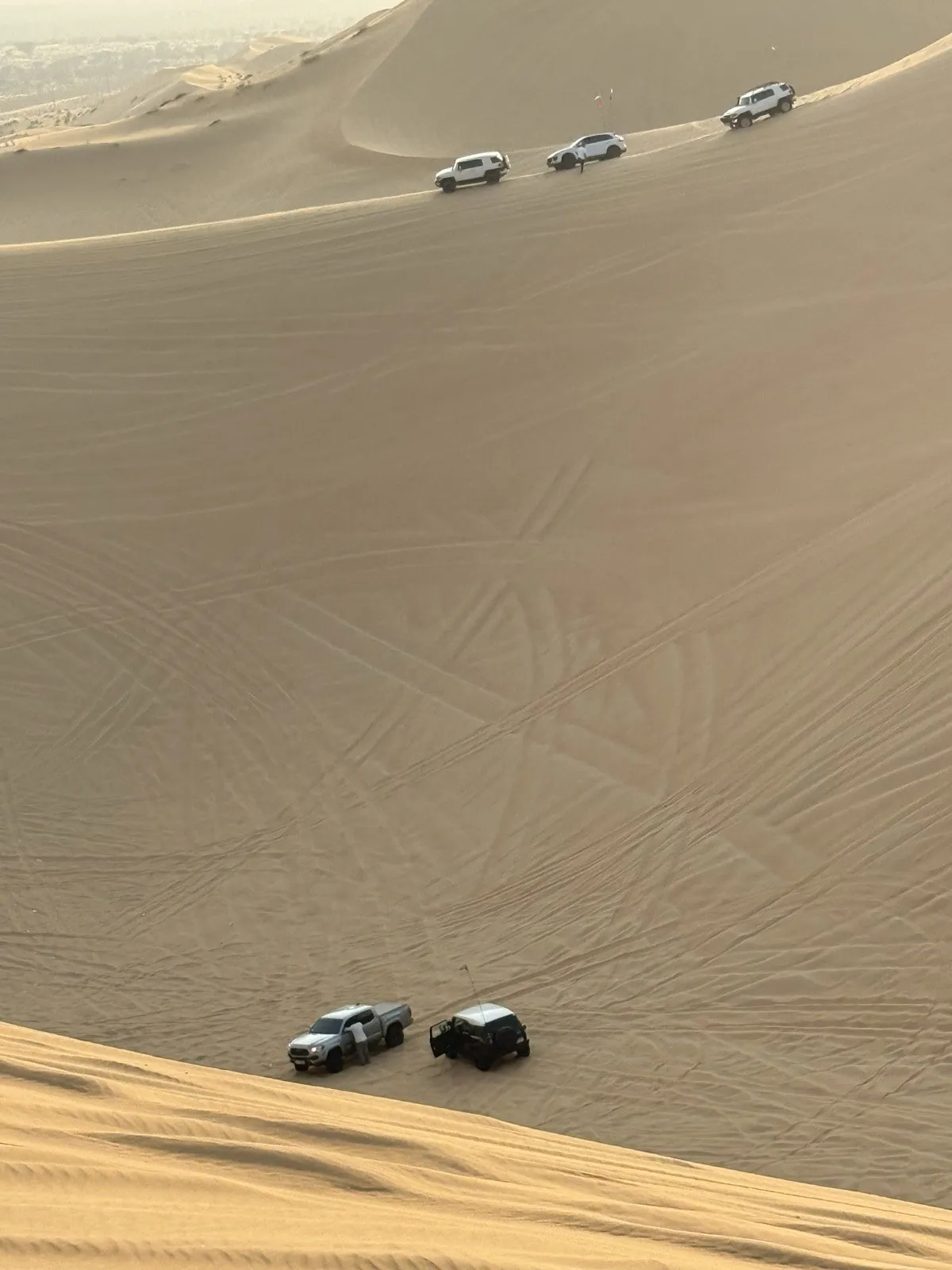
This guide is about driving so you don’t get stuck. If you’re already stuck, go to how to get unstuck from soft sand.
What do you set before the first dune?
At the edge of the sand, on firm, level ground, do three things: air down, engage four-wheel drive, and switch traction control fully off. Do all three before you reach the soft stuff, not once the car is already sinking.
- Air down all four tyres evenly. A softer tyre has a longer footprint, so it floats on sand instead of cutting a rut. We don’t print a number. The right pressure depends on your car’s weight, tyres and load and on that day’s sand, and copying someone else’s number is how tyres come off rims. Our airing-down guide shows how to find your number.
- Engage 4x4 at the edge of the sand. High or low range depends on your car: 4L gives more torque for soft sand and climbs, and many drivers (our founder included, in his Jeep) use it most of the time; cars with more power often drive in 4H. Check your manual, and see our guide to 4WD, low range and diff locks.
- Traction control fully off. Use the long press while you’re stopped, or the kill switch if your car has one. When a wheel spins, traction control cuts engine power. In sand that kills the momentum you need.
- Auto start/stop off, if your car has it.
How do you keep momentum without spinning the wheels?
Build your speed on firm, flat ground, then hold it on the soft sand with a smooth, steady foot. Soft sand takes speed away the whole time. If you lose it halfway up a face or in a soft patch, the only way to get it back is wheelspin, and wheelspin digs.
- Squeeze the throttle on. Don’t stab it. Stop-start driving spins the tyres and drains your speed. Land Rover’s own sand advice is smooth acceleration so the tyres don’t sink.
- Keep the revs up so the engine doesn’t bog down. This matters most with a petrol engine.
- Choose your gear before the soft section and hold it. Every gear change cuts drive for a moment. When the power comes back, the wheels spin. In an automatic, hold the gear (4WDing Australia).
- Use the throttle as your brake. On soft sand, easing off slows you for most of the drive. You’ll rarely need the pedal.
- Don’t overdo it. Speed you don’t need has to go somewhere at the top of the dune.
How should you climb a dune?
Go straight up the gentler windward face, one car at a time, with your speed built on the flat before the face. The pattern is: build speed on the flat, hold it on the face, ease off near the top, then crawl over square to the crest. Carnity’s UAE dune tutorial puts the lift-off point at about three-quarters of the way up. From there, momentum carries you.
Wait at the bottom until the car ahead is over the crest and clear. A failed climb comes back down the same line. As a beginner, climb windward faces and leave slip faces alone.
If you’re losing speed and won’t make it, turn the nose back down early, while the car is still clearly moving, in one smooth, wide arc. More throttle on a failing climb only digs the tyres in. Turn late and you end up across the face.
If you’ve already stopped, hold the car on the brake. Select reverse, straighten the wheels, and let the engine hold you as you back straight down in your own tracks. Never try a three-point turn on the face.
Is it OK to drive across a dune face?
Yes. Driving across a face with momentum is normal dune driving, and experienced UAE drivers do it on every trip. What’s dangerous is losing momentum while the car is tilted. Slow down on a tilt and gravity starts pulling the car down the slope. It slides, and a sliding car can roll.
- Hold a steady pace across. Slow down before the face or after it, not on it.
- Don’t brake while tilted.
- If the car starts to slide, turn the front wheels downhill straight away and drive down. A light throttle while you turn down is fine. Never steer uphill to “save it”.
- Anything heavy carried high, above all on the roof, makes a roll more likely.
As a beginner, only cross the faces you have to, with a club, while you learn how your car leans. Our guide to rollovers and side-slopes explains why it happens.
Why do sharp turns get you stuck?
When you turn the front tyres, they push a ridge of sand ahead of them. That ridge works like a brake. At full lock and low speed, the car ploughs to a stop with a wall of sand in front of the wheels, and now you have to pull away from there.
- Turn in the widest arc the ground allows, and keep rolling through the turn.
- If the car isn’t turning, steer less, not more. Extra lock just pushes a bigger ridge. BFGoodrich’s 4WD advice warns about the same ploughing in a sharp turn.
- Straighten the wheels while you’re still rolling, before you stop.
There’s a second reason to turn wide. On low tyre pressure, a sharp turn loads the tyre sideways and can pull it off the rim. Then it empties in seconds (tyre blowouts and de-beading). This catches people on the flat sand, where it feels safe to swing the car round.
Where and how should you stop on sand?
Roll to a stop on the firmest sand you can see, with the wheels straight and pointing the way out. On a slope, stop facing downhill. Braking hard leaves a wedge of sand in front of every tyre. Rolling to a stop doesn’t. Facing downhill lets gravity help you pull away. Gulf News’s UAE desert-driving tips and Isuzu’s sand guide both give this same advice.
Never stop:
- on a crest, or just below one;
- at the bottom of a bowl (easy to get into, hard to get out of);
- at the foot of a face where other cars come down.
The other drivers can’t see you there.
Pulling away again: wheels straight and a little gas, with no wheelspin. If the wheels start to spin, ease off at once. Full throttle from a standstill just digs a hole.
How do you read the sand before you drive on it?
Look first, then test. Colour, ripples and smooth patches tell you where to look more closely. They never tell you it’s safe to drive.
- The boot test. Press a boot into the line you plan to drive, then push your heel through it.
- Your own tracks are today’s baseline. If they start cutting deeper, stop and think again. Don’t add throttle.
- Morning firmness is a thin crust. The cars ahead of you may already have broken it.
- The last stretch before a crest is usually the softest. That’s why cars bog just short of the top.
- Drive around bushy mounds. The hard root core stops a wheel dead, the sand behind it is soft, and buried stems can cut a sidewall. They cut it more easily the lower your pressure.
- Old tracks and saved routes are history. Wind rebuilds crests. A GPS line can be a few metres off, which is the whole width of a crest edge. Use them to find the area, then read the ground yourself.
For the dune shapes themselves, see our field guide to desert landforms.
What do you do at the top of a dune?
Get to the top slowly and square to the crest, slow enough that you could stop before the lip. Going over at an angle can drop one side down the slip face and start a roll. Going over fast puts the car in the air, and it lands nose first.
- If all you see is sky where the ground should be, stop. Walk up and look. The crest and the real edge of the slip face can be several metres apart, and the edge can overhang, so stop short of it.
- Fresh, smooth, tongue-shaped lobes running down a face mean it avalanched recently. Don’t cross.
- Don’t steer or brake while the wheels are light going over.
- A founder’s tip: when the crest line passes your shoulders, you’re across.
- Don’t stop on the crest or just past it. Someone may be coming up the other side.
Deciding not to cross is always a move you can undo.
How do you go down a slip face?
Go straight down the fall line in a low gear and let the engine do the braking. Line the car up before the front wheels go over.
- Use little or no brake. If you’re going too fast, pulse the brake gently. Never brake hard, and never brake while tilted. Hard braking makes the front plough, and the back swings round.
- If the rear starts to slide round, a touch of throttle pulls it straight again.
- Look at the bottom before you go. The deepest sand collects there, so make sure there’s room to keep rolling and nobody in the way.
What do you do the moment the wheels spin?
Lift off the throttle. When the car stops moving forward, more throttle doesn’t drive you. It digs. You’ll know it’s happening when the engine note rises but the view through the windscreen stops moving. Land Rover and BFGoodrich both give the same first instruction: ease off and let the tyres find grip again.
Then get out and look at all four wheels and underneath the car before you do anything else. If the car is across a slope, get out on the uphill side. Stopping in the first second or two usually makes this a short job. Spinning on makes it a long one.
From here, follow our step-by-step guide to getting unstuck from soft sand. It covers checking whether you’re bellied, airing down further, digging and rocking the car out.
The mistakes that get people stuck, and what to do instead
| Wrong move | What happens | Right move |
|---|---|---|
| Driving onto the sand at road pressure | The tyre cuts a rut and the car digs in | Air down at the edge of the sand (how) |
| Stabbing the throttle, stop-start | The wheels spin, speed drains, the car bogs | Build speed on firm ground, then keep a smooth, steady foot |
| Leaving traction control on | It cuts power mid-climb and your momentum is gone | Switch it fully off before the soft sand |
| Changing gear on a face | Drive drops for a moment, then the wheels spin | Choose the gear before the face and hold it |
| Full lock at low speed | The front tyres push a ridge and the car ploughs to a stop | The widest arc you can, less steering, keep rolling |
| Braking hard to stop | A wedge of sand builds in front of every tyre | Roll to a stop, wheels straight, facing downhill |
| ”One more second of throttle” on a failing climb | The tyres dig in, and a late turn leaves you across the face | Turn down early while still moving. Stopped? Reverse straight down in gear |
| Braking or steering uphill while tilted | The car loses momentum, gravity pulls it down, it slides and can roll | Keep momentum. If it slides, wheels downhill, no brake |
| Flying over a crest | The car goes airborne and lands nose first on the slip face | Ease off near the top, crawl over square, look first |
| Braking hard on the way down | The front ploughs and the back swings round | Low gear, engine braking, pulse the brake if too fast |
| Staying on the gas when the wheels spin | The car digs itself down onto its belly | Lift off at once, get out and look |
What should your first dune day look like?
Our advice: don’t make a dune your first sand. Go with a club or an experienced driver, and drive a practice loop on flat, open sand first:
- Pull away with no wheelspin.
- Make a wide turn.
- Roll to a stop with the wheels straight.
- Get out and look at your tracks.
- If the car is working hard, adjust your tyre pressure and go again.
Move on to small windward faces only when the car pulls away cleanly on the flat. Never go with only one car. Our easy spots near Dubai are a good place for that first loop. If you want someone in the passenger seat the first time, there’s our beginner course. For the full picture of getting started, read how to start off-roading in the UAE.
Record the drive in the OffroadPal app, then look back at your line afterwards. You’ll see where you slowed down, and where you would have got stuck.
Sources
External pages we opened and checked on 14 October 2026. Each is the advice of its own author; where our guide says “Land Rover’s own advice” or similar, this is the page.