
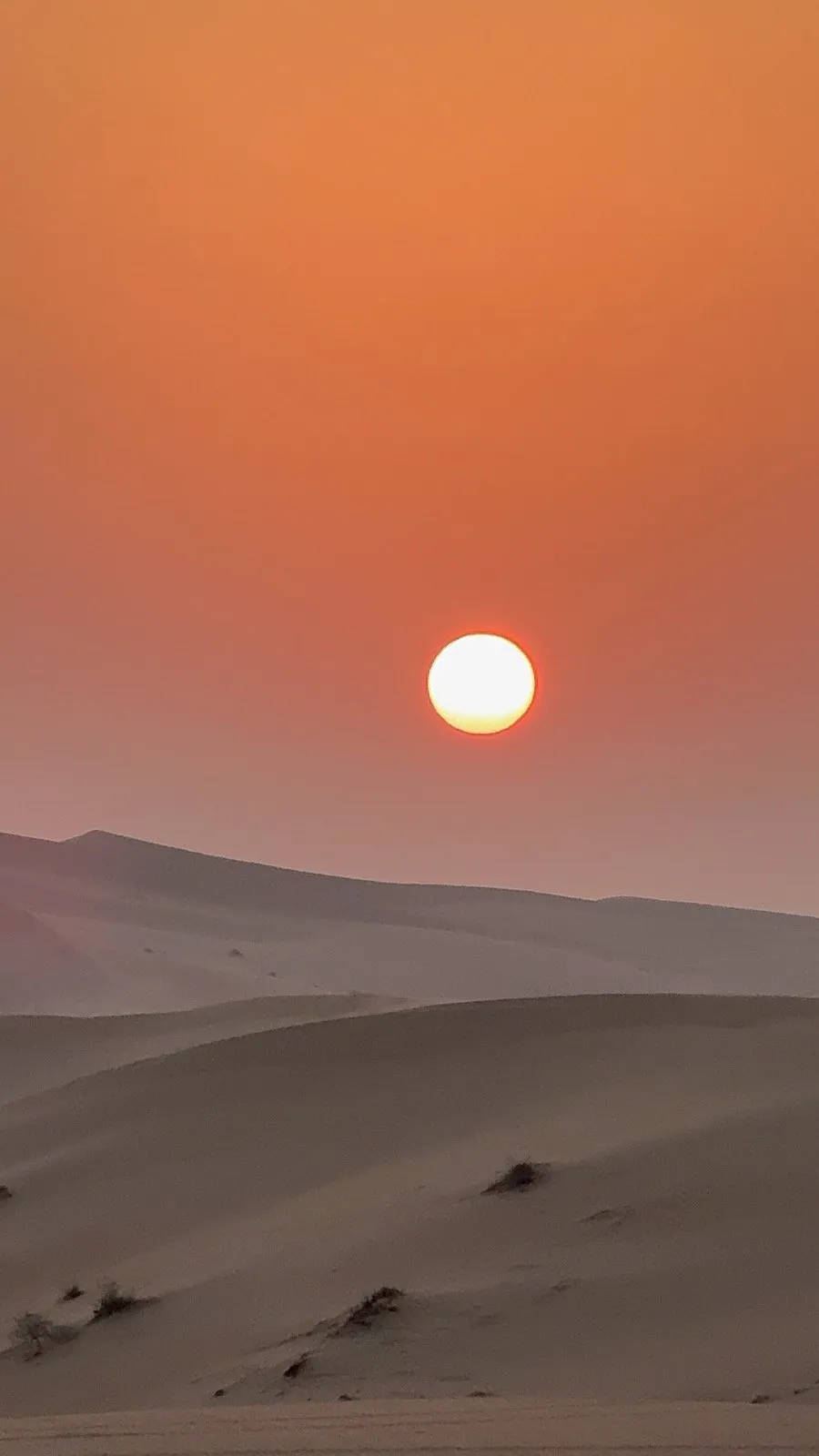
Two dangers, opposite shapes
Most desert weather is an inconvenience. Two UAE events are genuinely dangerous, and they’re dangerous in opposite ways: the sandstorm announces itself — a wall you can see — and kills through what drivers do in it; the wadi flood hides — the rain fell somewhere else, hours ago — and kills through where people chose to stand. Different rules for each. Dated facts throughout, because both the law and the records changed recently.
Sandstorms: the visibility collapse
When the national forecaster (NCM) issues dust alerts, the numbers run in tiers — visibility below 3,000, below 2,000, below 1,000 metres; in severe events reports have gone under 500. The collapse takes minutes, and the killer isn’t dust in your lungs — it’s the car behind you.
On the road:
- Slow hard. In the thick of it, think under 30 km/h, and open a long gap to the lights ahead.
- Low-beam headlights on. Hazards OFF while moving — police guidance is explicit: flashing hazards while driving hides your lane changes and indicators from everyone behind you. Hazards are for when you’ve stopped.
- Windows shut, AC on recirculate.
- Too thick to continue? Get fully off the road — as far from live lanes as the ground allows — hazards on now, stay in the car, wait. Never stop in a lane: the low-visibility rear-end pile-up is the signature sandstorm accident.
Off-road, in the dunes:
- Stop. There are no lanes and nobody behind — the risk is driving blind over a crest, or two convoy cars finding each other the hard way.
- Note your heading before visibility goes. The wall is visible minutes out; that’s your window to log the way back.
- Group up, lights on, wait. Desert dust squalls usually pass in minutes to an hour. Your convoy’s shared positions do the navigating that eyes can’t; movement earns nothing.
Wadi floods: the danger that arrives under blue sky
A wadi is a dry valley that becomes a river when it rains — and here’s the mechanism that catches intelligent people: the rain that floods it falls in the mountains, hours earlier, kilometres upstream. The sky above your lunch spot stays blue while the water is already travelling toward you.
The scale is not theoretical. In April 2024 a gauge at Khatm Al Shakla near Al Ain recorded 254.8 mm of rain in under 24 hours — the UAE’s highest since records began in 1949. The wadis that drain events like that move cars, containers and people.
The rules, in order of importance:
- Never enter or cross a flowing wadi. Moving water floats vehicles — and since the traffic law in force from 29 March 2025, it’s also AED 2,000, 23 black points and a 60-day impound, rising to a minimum year in jail and AED 100,000 if someone dies. The gathering-to-watch crowd is covered too: AED 1,000 and 6 points for congregating near flowing valleys and flood channels.
- Check the catchment, not your campsite. Rain forecast anywhere upstream — RAK, Hatta, Fujairah, the Hajar broadly — means flood risk in wadis downstream, whatever your sky says.
- Never camp on a wadi floor in the rainy months. It’s flat, sheltered and inviting — it is also, precisely, the riverbed. Camp on high ground and sleep well.
- If water starts rising, go up immediately — and abandon the car if that’s what it takes. Cars are replaceable; the current doesn’t negotiate.
The common thread
Both dangers reward the same two habits this whole site keeps arriving at: check conditions before you go — the when-not-to-go list exists for exactly these calls — and be with people: a convoy that shares positions turns a sandstorm from disorienting to boring, and makes sure somebody is missing you the moment anything goes wrong.
The honest footer
Penalty figures are as reported from the federal traffic law in force since 29 March 2025; laws change and the fine schedule is the government’s to update — check current guidance rather than treating this page as legal advice. Weather figures are from the national forecaster’s published alerts and the April 2024 record as reported. Nothing here asserts that any conditions are safe: forecasts miss, catchments surprise, and the desert’s weather rules are enforced by physics before police.