
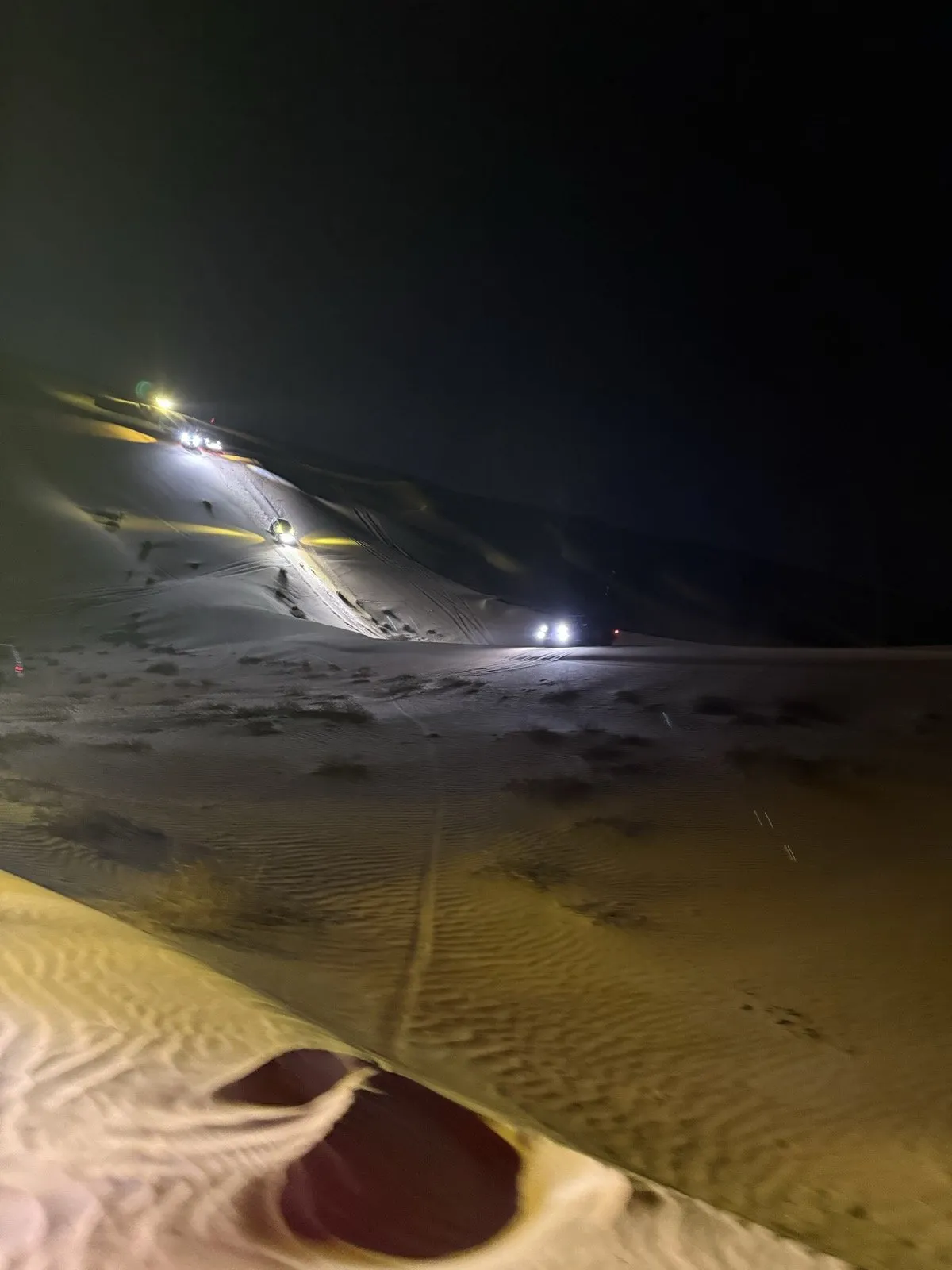
What actually disappears after dark
Daytime sand driving runs on one skill above all others: reading the ground. And you read sand through shadow. The low sun draws every ripple, every crest line, every slipface edge; the difference between a rolling dune and a sudden drop is a band of shade your eyes process without you noticing.
Headlights delete that. Light thrown from your own eye line renders sand flat — a ten-metre slipface and a gentle roller can look identical until you are a car length away. Depth perception, crest edges, the texture change that says soft — the information a sand driver depends on simply is not there. That is why night driving is a different sport, not a harder difficulty setting of the same one.
What gets more dangerous, specifically
- Crests become blind twice over. Daytime rule: approach square and slow, look over before you commit. At night you cannot look over — there is only black past the edge. Walking-pace crests or don’t take them.
- Other people vanish. Campers pick bowls and dune shadows precisely to be tucked away. After dark a camp with its fire burned down is invisible from above until you are on the rim — with your lights pointing up at the sky, not down at their tents. The busy weekend areas around Al Badayer and Sweihan hold more of these surprises, not fewer.
- Getting lost gets easy. Landmark navigation dies with the light; every dune line looks the same in a headlight cone. Offline maps with your live position stop being a convenience and become the navigation.
- Recovery is slower and worse. Finding an anchor point, reading how a car is bogged, keeping people out of the rope’s path — every step of a recovery is clumsier by torchlight, with the desert cold or, in summer, still dangerously hot.
- The injury pattern is real. The UAE’s own emergency-medicine researchers, studying four years of quad-bike casualties rescued by Dubai ambulance, found the severe head, neck and spine injuries concentrated in night riders. Quads are not 4x4s — but the mechanism they describe, rollovers on unseen ground at night, is exactly the one this page is about.
Why people are out there anyway
Honesty requires the other half: night is when the desert is at its best for much of the year. In the hot months the sand cools after sunset and local desert culture — the drives, the camps, the late-night karak — runs on that clock. And the sky is the payoff: a moonless night at Al Quaa is the best free show in the Emirates.
None of that needs a beginner to be driving dunes in the dark. You can drive in on the tracks in daylight, camp, watch the sky all night, and drive out after sunrise. Same magic, none of the blind crests.
If your group does drive at night
The clubs that run night drives treat them as their own discipline, and their shape is worth copying exactly:
- Known ground only. The lead has driven this exact area in daylight — recently. Night is not the time to explore.
- Slower everything. Crest approaches at walking pace, bigger gaps between cars, no showing off. Speed plus invisible ground is the whole accident recipe.
- Lights and flags on every car, and live positions shared — on the radio, or on one map in the app — so a car that stops is missed in seconds, not kilometres.
- Watch for camps from below, not above. Skirt bowls rather than cresting into them.
- Full moon beats no moon for driving (and no moon beats full moon for stargazing — pick the night for the plan).
- Everything from the daytime rules still applies — aired-down tyres, recovery gear, never alone, and the when-not-to-go list applies double.
The honest footer
Nothing on this page asserts that night desert driving — in any group, at any speed — is safe. It is a higher-stakes version of a sport that already punishes overconfidence, and this page exists mostly to say: not in your first season. The desert at night is worth seeing. See it from a camp chair first.