
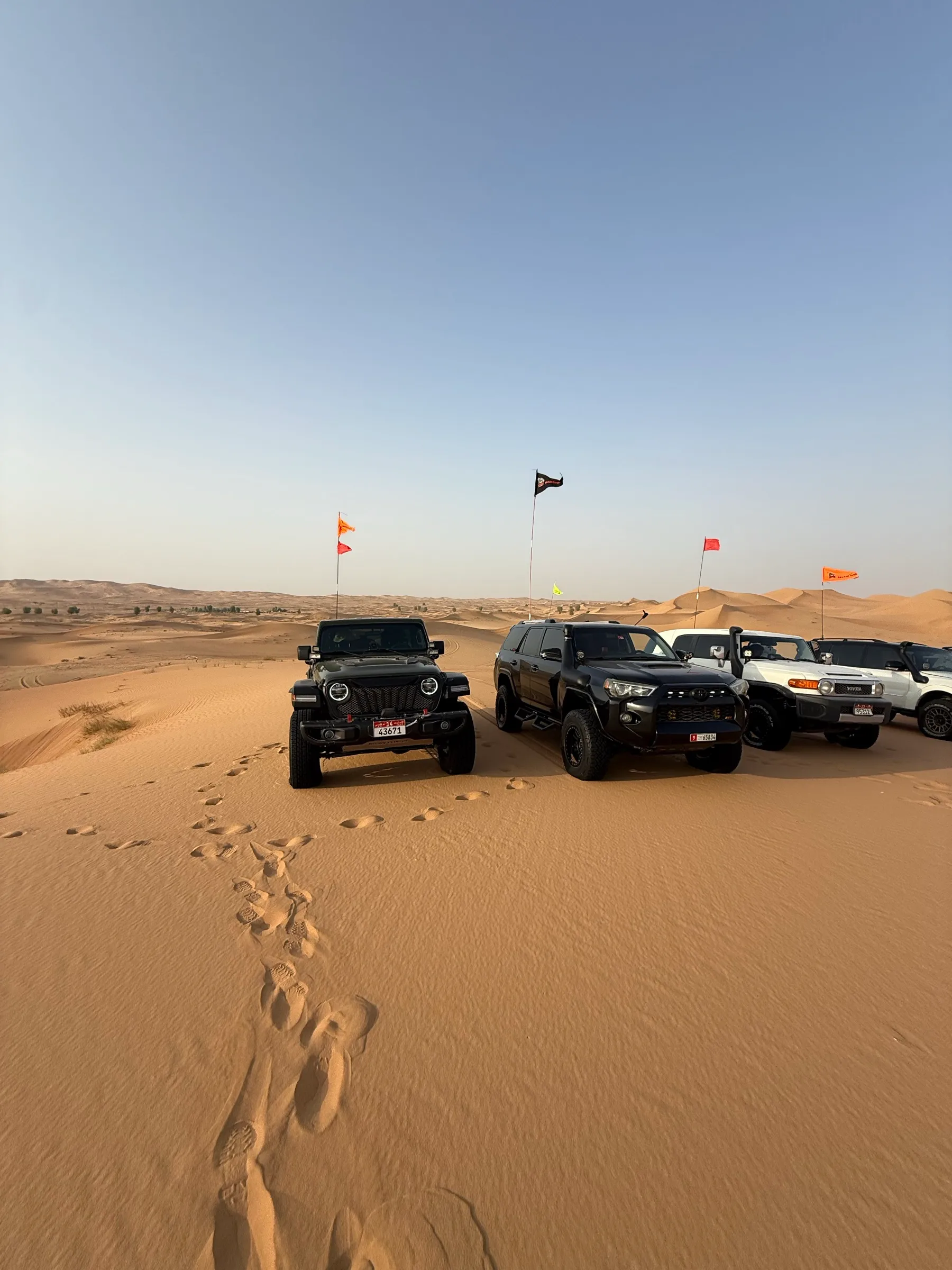
Three is the unit
Ask why experienced UAE groups keep arriving at three cars and the answer is arithmetic, not tradition. Two cars is fragile: one stuck leaves exactly one recoverer — and if the second car bogs during the recovery (it happens; soft sand around a stuck car is soft for everyone), the day is over and the walk is long. Five or more is slow: every crest, every soft bowl, every decision multiplies by the queue. Three gives you a recovery reserve, a manageable line, and one radio conversation.
Our convoy etiquette guide covers how everyone in the line behaves. This page is about the two cars with jobs.
The lead: pace, line, patience
Everything the lead does is for the cars behind it:
- Reads ahead and talks. The lead’s eyes live a couple of hundred metres out — announcing line changes, soft patches and stops on the radio before they arrive.
- Sets the ceiling, not the record. The pace is whatever the slowest driver can hold without panic. A lead that has to be chased teaches the newest driver to drive beyond their reading — which is how rollovers get manufactured.
- Owns the route. At every fork, the lead decides. Committee routing over the radio is how convoys end up on two different dunes wondering where everyone went.
- Waits at crests. The lead stops where it can see back, and moves on only when the sweep confirms the line is intact.
The sweep: the back door that never opens
- Always last. Never overtaken. No exceptions, ever — the whole accounting system of a convoy is that everything ahead of the sweep is everybody.
- Calls the count. “Everyone’s through” after each waypoint is what frees the lead to continue. Silence from the sweep stops the convoy — that’s the design working.
- First responder. A car drops out of the mirror line, the sweep is on it — which is why the sweep should carry (and know) the group’s recovery kit.
- Carries the long-range lifeline on remote trips — satellite communication belongs in the sweep and lead when the trip leaves phone coverage for real.
The best sweep drivers are usually the most experienced in the group, not the newest — the back of the convoy is where problems surface, and it’s the worst seat to learn in.
Sizing the convoy to the ground
Club practice across the UAE converges on roughly this:
| Trip | Cars | Notes |
|---|---|---|
| Sweihan / Lahbab day | 2–3 | One radio channel, busy area, help nearby |
| Wadi / east-coast loops | 3 | Mixed experience is fine with solid lead + sweep |
| Liwa weekend | 3–5 minimum | All experienced; satellite comms in lead and sweep |
| Empty Quarter crossing | 5–7 | Two full recovery kits; satellite comms in every car |
The pattern: the more remote, the more redundancy — of cars, of recovery gear, of ways to call out. Remoteness doesn’t make the driving harder so much as it makes every problem permanent.
The solo footnote, again
Stranded solo drivers get rescued from the UAE desert every winter, and the pattern behind those stories is constant: most would have been a ten-minute tow if a second car had been there. Driving remote desert alone is a survival risk, not a flex. No second car? That’s what clubs are for — and finding a convoy is precisely the job the app was built to do.
The honest footer
Convoy sizes and role rules on this page reflect long-standing UAE club practice, not law — and no convoy structure asserts that a drive is safe. Roles fail when egos drive: the day the sweep gets overtaken “just this once” is the day the count stops meaning anything. Structure is cheap; use all of it.